
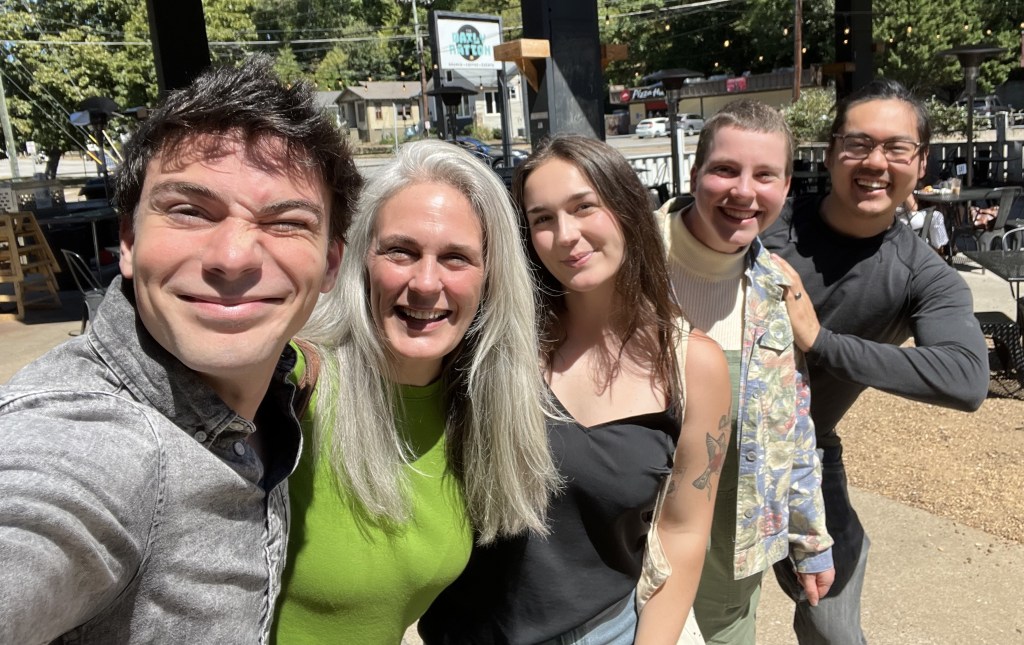
Who: John, Sydney, Ace, and Chance
Church: Mission Red Bank (Anglican)
Lunch: The Daily Ration
Topics: Partnership with the Lord, Suffering, and the Uncertainty of Life
When I first started this project, I had several friends invite me to their Sunday morning gatherings, several of Sydney’s friends as well. And despite her being in Huntsville part time, Sydney has been in town the past few Sundays and I’ve really enjoyed her being a part of the discussions. Faith has ALWAYS been a part of our lives. Not just doing the church thing… but deep conversations about Jesus, the purpose of life, and real cost of discipleship. At the end of the day, I really don’t think our family knows how to do the superficial and shallow and that makes a lot of people uncomfortable… especially in the south.
But, we’ve still been able to find our people here.
For my third week, we visited our friends at Mission Red Bank, which was a return to home for Sydney in a lot of ways. She was a part of this church community for a while, so she knows a lot of people here. I also think it’s one of the reasons she felt so at ease during worship. At one point, Sydney even leaned over and commented on how much she appreciated the worship style and song choice. It was simple, not showy. It was a chorus of voices, not the elevation of one. (I feel like this might come across as a footnote in the post, but as a mom, this is actually a big deal and a beautiful example of healing that I want to acknowledge.)
There are a few key points from the sermon that I want spend time on and unpack. The first being this idea that we’re all living out our stories… but are we doing it in a fruit bearing way? The pastor offered some context by distinguishing between the active voice of our story (focused on what we are doing) and the passive voice (focused on what God is doing). But, he went on to suggest there’s a third alternative, a”middle” voice, that exists within the partnership we have WITH God.
As we sat down for lunch, our conversation naturally turned to processing this idea, leading us to reflect on the COVID pandemic and the widespread challenges people faced in adapting to long-term change. It’s important to clarify that this isn’t a critique of the protocols implemented during the pandemic, but rather an observation of how those measures impacted certain individuals in our communities.
Personal suffering can be a theological landmine. Discussions around the topic can lead to emotionally charged, or challenging, theological questions, which, if not navigated carefully, may provoke doubt, conflict, or a crisis of faith. At the risk of oversimplification, or platitudes, it can challenge our belief in a loving God. It often raises profound theological questions about the nature of evil, free will, and divine intervention—questions that have been debated for centuries and offer no universally satisfying answers.
Not wanting to get into the weeds, here’s one of the biggest takeaways I had from our conversation during lunch: Sometimes, out of our inability to change, we can create false narratives about our lives, or ourselves: We’re not smart enough, creative enough, strong enough. And from these false narratives, we can create additional false narratives.
Imagine someone who has experienced repeated failures at work or school. Over time, they start to internalize a belief that they’re not smart enough to succeed. This becomes their core narrative: “I’m just not intelligent enough.” Because of this belief, they might stop trying to take on new challenges, or avoid opportunities for growth, reinforcing their perceived lack of ability.
From this core false narrative, they start creating additional ones. For instance, “I’m not creative enough to find solutions to my problems,” or “I’m not strong enough to handle setbacks,” or even “I’m not deserving of success because I always fail.” These narratives start to influence their behavior, making them less likely to take risks or pursue new opportunities, further trapping them in a cycle of self-doubt and limiting their potential.
Each layer of false narrative builds on the last, creating a self-perpetuating story that feels real but is actually a distortion born from their inability to adapt to initial challenges. Over time, this can shape their entire sense of identity, limiting their growth and opportunities. And sometimes, if we stay stuck in these false narratives, we begin to claim them as our truth. And I think this is a great place where we can meet that middle voice, where we can ask God to partner with us to identify the core issue and help us tear apart the false narratives.
One other element of the sermon that I feel needs attention: Believing in Jesus is more than an intellectual exercise. True faith in Jesus involves more than just agreeing with theological doctrines or accepting historical facts. It requires a deep, personal commitment that transforms the heart, shapes one’s actions, and permeates every aspect of life. As a follower of Christ… I have to actually follow him.
But as someone else said over lunch: The potential of me isn’t limited to me. And this made me think of something else from the sermon. The pastor reminded the congregation that manna sustained the lives of the Israelites when they were in the wilderness. And so often I’ve heard pastors refer to the Bible as our modern day manna. However, I believe that comparison oversimplifies the depth of what we truly need.
In the same way that God met the Israelites’ physical needs with daily bread, He offers us spiritual nourishment through His word. But, I also believe that our spiritual and personal potential is also sustained and guided by something beyond ourselves… his presence. I keep getting drawn back to this.
And as I sat with these four 20-somethings over lunch, I was also struck by the reminder that manna, which was an external gift given to meet the Israelites’ needs, our personal growth, talents, and achievements are often nurtured by external forces—whether divine intervention, community support, or spiritual instruction from the Bible. And I believe that the potential within us is connected to a greater purpose beyond our individual needs. It suggests that our lives, talents, and abilities are meant to impact others and serve a higher calling.
There are so many uncertainties in life. The simple truth is that many of us live like we’ll be around for 50 or 60 more years. But the reality is that we could be gone tomorrow. So continuing to waste our times on false narratives and belief systems is not only unwise, it robs us of the opportunity to live authentically and purposefully in the present. Clinging to what isn’t true or meaningful distracts us from the deeper purpose and fulfillment that comes from living with intention, clarity, and truth.
I also felt a twinge of pain and hope during our lunch as Sydney explained to us how despite the trauma she has experienced from those within the institutional church, she still feels called to the REAL church. And I get it because I feel the same way. I think the REAL church, the bride of Christ, is found in our shared commitment to embodying Christ’s love and compassion, transcending our past wounds to create a space for hope and renewal.
But we have to want to create that space.
CHALLENGE: Ask the Lord for wisdom in where I need more intention, clarity, and truth.
 Searching for Jesus in A̶m̶e̶r̶i̶c̶a̶ Chattanooga