
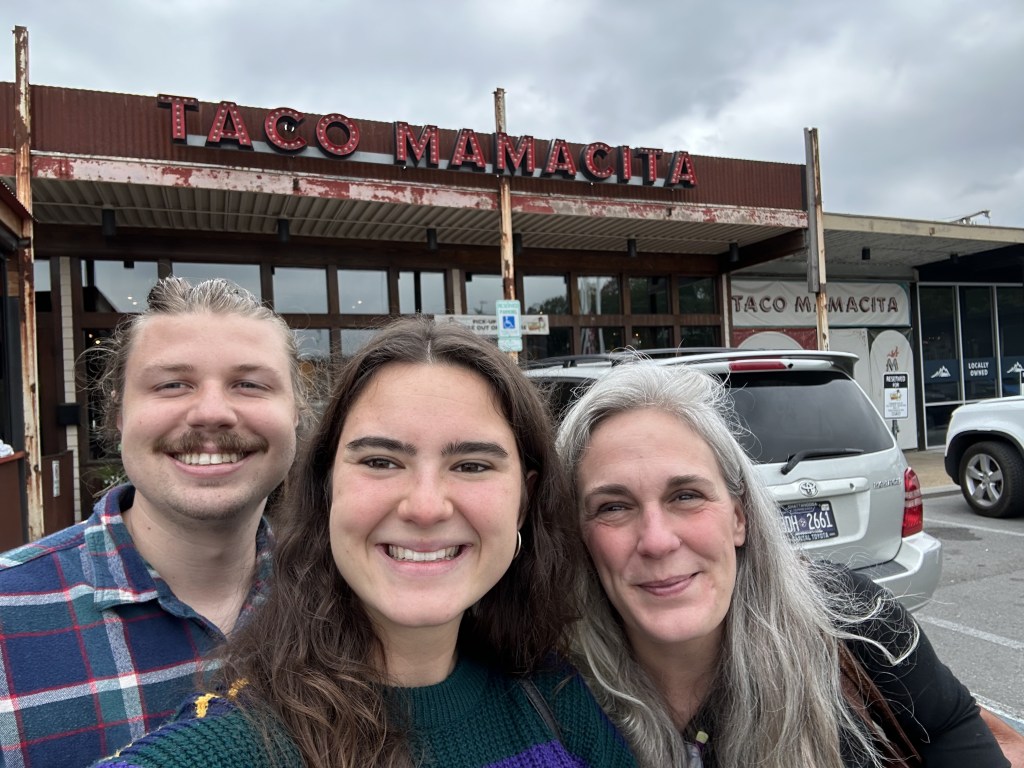
Who: Katie and Clay
Church: North Shore Fellowship (Presbyterian)
Lunch: Taco Mamacita
Topics: Living by Faith and Not Having All the Answers
This week, I crossed the river to join Clay and Katie at North Shore Fellowship. I met these two wonderful people through my kids, but they’re also happen to be monthly donors to BTCYI. (And if Katie looks familiar, you might recognize her from Be Caffeinated, where she works as a barista!) I appreciated our time at North Shore Fellowship, but it was our conversation after the service that truly left me feeling encouraged and inspired.
Both Katie and Clay were raised in the church and have an acute awareness of cultural Christianity, especially in the South, as well as the political phenomenon known as Christian nationalism—how religious identity is sometimes blended with patriotism in ways that influence politics, community dynamics, and even individual beliefs. And during our conversation over lunch, both Katie and Clay shared a thoughtful approach to faith that challenges assumptions and emphasizes authenticity over cultural expectations.
Yet another reminder as to why I have confidence in the future. (Besides Jesus, of course.)
With regard to the Sunday morning service, North Shore Fellowship reminded me a lot of my Grandma’s church growing up. Both the building and the people. And the bulletins. (I still remember countless Sunday mornings filling the margins of those bulletins with doodles and drawings.) The building itself is old, but that also holds some of it’s charm. The demographic is primarily caucasian. But there was a lot of generational diversity. And, weirdly enough, I didn’t recognize one single worship song. It was VERY old school, but it was also very beautiful.
And, I’ll be honest, I can’t remember what the sermon was about, except it was based on a section from the book of Daniel. Confession: I’ve been distracted the past couple of weeks. And while it might be easy to say the election was the reason, it wasn’t. At least not when it comes to the actual source of the distraction. There’s a clear divide in our country and animosity runs deep… on both sides. But, there’s also a clear divide in the “American Church” that is deeply disconcerting.
And this has been the distraction for me, and my family, for quite some time. And I’d be lying if I didn’t acknowledge that the repercussions of this election, NO MATTER THE OUTCOME, have taken up a lot of space in my mind. But, I also think this conversation with Katie and Clay helped me sort through some of those thoughts and feeling because their perspectives brought a sense of clarity and grounding.
Having both been raised in the church, their familiarity with cultural Christianity gave them a deep understanding of the nuanced blend of faith and tradition, and how easily inherited values can go unquestioned. This has helped them navigate their own beliefs with a balance of respect for their roots and a desire for authentic faith. This background made our conversation more insightful; they could empathize with the struggle between living out a genuine relationship with faith versus just going through the motions.
One of the things I’ve come to understand about religion, particularly within the Christian tradition, is that many people approach their beliefs as absolute truth. At its core, it comes down to this: our beliefs are what we accept as true, often without concrete evidence to support them. This is part of the very nature of faith—it’s the conviction in things unseen and unproven. In a sense, truth in this context isn’t about measurable proof; it’s about what we choose to hold onto as reality.
The downside of approaching beliefs as absolute truth, particularly in a religious context, is that it can foster rigidity and close us off to other perspectives. And before anyone accuses me of heresy—I do believe there are absolute truths that come with a commitment to following Jesus. However, I also recognize that, within our faith tradition, some people tend to elevate certain beliefs to the level of universal truth when, in reality, they may be more reflective of personal convictions. This distinction is important because mistaking personal convictions for absolute truth can lead to unnecessary divisions within our faith community, unintentionally closing themselves off from dialogue, critical thinking, or the possibility that other perspectives might have value. This rigidity can sometimes foster division, as differences are seen as threats rather than opportunities for growth or understanding.
When I think about the massive wave of deconstruction that gained visibility in the 2010s and early 2020s—fueled by social media’s open and communal discussions of faith struggles and doubts—I see how questioning what we’ve accepted as true can actually deepen our understanding or strengthen our faith. Without this process of examination, we risk cognitive dissonance; when our lived experiences or evidence clash with long-held beliefs, it can create a crisis of faith or identity that feels destabilizing rather than enlightening. Deconstruction, then, becomes a pathway to reconcile belief with experience, offering an opportunity for growth rather than disillusionment.
In Katie and Clay, I saw a rare humility—one that allowed them to honor the tradition they were raised in while courageously questioning teachings and experiences that didn’t seem to align with the core teachings of Jesus they hold dear. Their approach wasn’t about discarding their faith but refining it, discerning between inherited beliefs and the heart of Jesus’ message. This willingness to wrestle with difficult questions showed a deep respect for their faith, as they sought an authentic expression of it, and a true determination to seek the heart of Jesus.
CHALLENGE: Reflect on your own beliefs and traditions. Are there aspects you’ve accepted without question that might benefit from a closer look to find a more authentic connection to the teachings of Jesus?
 Searching for Jesus in A̶m̶e̶r̶i̶c̶a̶ Chattanooga