
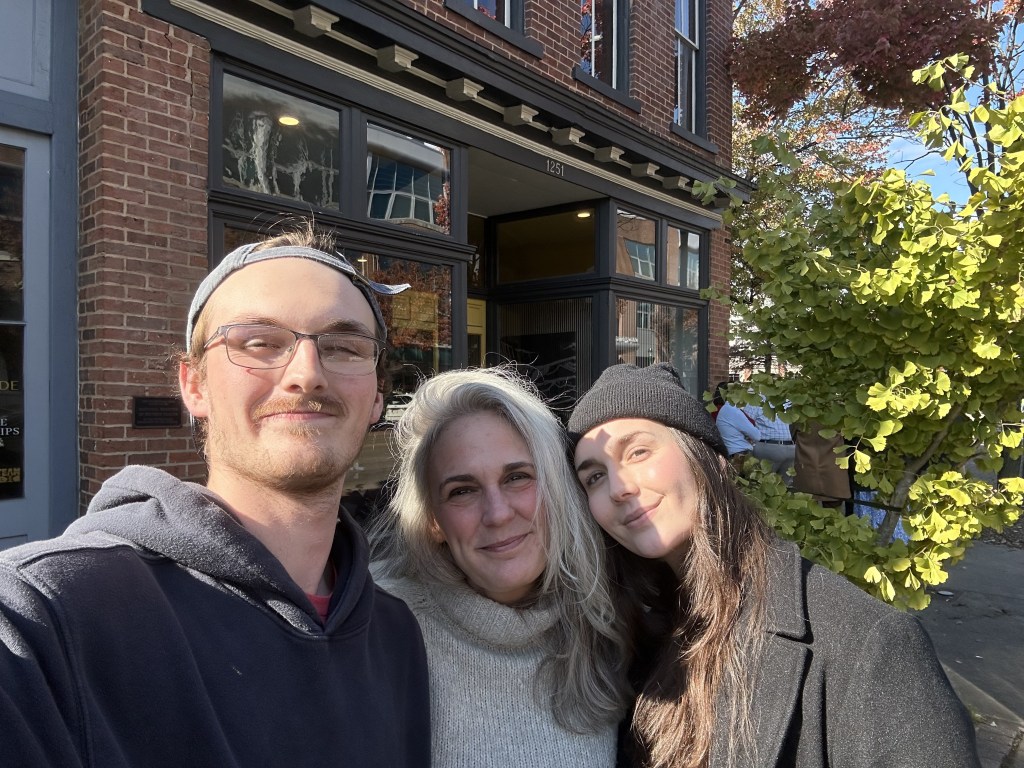
Who: Brayden and Sydney
Church: City Collective
Lunch: Kenny’s
Topics: Parenting, Church Hurt and Healing
I’m starting the fourth month of this project and it seemed only fitting to revisit our home church in Chattanooga. I think it’s good for grounding, but also… I miss those humans. Sydney and Brayden were in town this past week for Thanksgiving and with it being the beginning of Advent… it just felt right.
If you happened to know our family before we lived on the road, you know that we’ve experienced our fair share of “church trauma” that deeply impacted not only our spiritual lives but our personal relationships, leaving lasting marks on how we view community, trust, and belonging.
Church trauma can be complex, often involving feelings of betrayal, judgment, or disillusionment with institutions, or individuals, we looked to for guidance and care. For us, it led to a season of wrestling with questions about faith, identity, and where we fit in. Yet, through that pain, we also began to learn the importance of healing, authenticity, and finding spaces where grace prevails.
While some of those experiences were deeply problematic, they’ve also given us a unique perspective—one that fuels our passion for fostering safe, inclusive environments where others can feel seen, heard, and loved for who they are. (One of the reasons our non-profit has this tagline is deeply rooted in our interactions with youth across the country who have also experienced church trauma.)
But today I want to pivot to something just as vulnerable and meaningful: parenting—and how, even with the best intentions, we can sometimes unintentionally add to the hurt or, at the very least, fail to ease it.
If church trauma taught us anything, it’s that the environments we create and the ways we lead profoundly matter. And as parents, we hold the responsibility of shaping not just our kids’ understanding of the world but also their understanding of themselves, of love, and yes, even of God. That’s a weighty thing to carry, and let’s be honest: we don’t always get it right. In fact, sometimes, the very things we think we’re doing to protect, or guide, them can end up causing hurt.
Parenting through the lens of our own wounds—whether those come from church trauma, past relationships, or personal insecurities—can be tricky. Yet, those very wounds can also lead to powerful growth and redemption in the way we parent. For me, some of the most meaningful changes have come directly from facing the pain of my own childhood experiences and choosing to do things differently.
As someone who grew up in an abusive home, I made a firm promise to myself: the cycle of harm would end with me. I am deeply grateful to say that this pattern of abuse has been broken, and my children have grown up in a home where love, not fear of physical harm, guide our relationships. But, perfection is not attainable in parenting and we still project fears, impose expectations, or unknowingly echo patterns we swore we’d never repeat. And while it’s hard to admit, there are moments when our own brokenness becomes the weight our kids carry.
Over the past few years, I’ve been reflecting on something deeply personal—how our parenting style and practices were shaped by the institutional church and, in some ways, how they contributed to, or even deepened, the trauma we experienced within that environment. Maine is about as polar opposite to Tennessee when it comes to church communities, particularly in terms of religious culture and engagement. While Tennessee is deeply rooted in the Bible Belt with a strong emphasis on church attendance, evangelical traditions, and vibrant community involvement, Maine tends to have a more secular culture, with lower church attendance and a less prominent role of religion in daily life.
But, our family was deeply invested in the church community in Maine (and in Rhode Island when we were church planting). And with that, our kids got a front row seat… to a lot. So, as I sat down with Sydney and Brayden over lunch we started to dig into all of it. (For the sake of context, I will say that while we typically attended conservative leaning churches, we were usually more moderate in our perspectives, often valuing open dialogue, questioning, and a focus on grace over strict adherence to dogma or political alignment.)
While no specific situations were discussed , we did focus on the profound yet often imperceptible journey toward attaining the perfection of Christ… and the guilt and shame that can arise when we inevitably fall short. This tension between striving for holiness and grappling with our human limitations often leaves believers feeling burdened, as if their efforts are never enough. And here’s where the “old Deirdre” would have waxed on about the liberating truth that Christ’s perfection is not a standard we achieve through our own strength, but a gift of grace that transforms us over time.
I honestly cringe thinking about it. It’s such a surface-level, white-washed answer that offers little depth or real-world application, failing to address the complexities and struggles people actually face. It feels dismissive, as though it’s designed to check a box rather than engage in meaningful dialogue or provide genuine support.
Over lunch, Brayden shared about the weight, as well as the subsequent guilt and shame, that accompanies the standoff between the ideal we’re striving for and the inevitable ways we fall short. The “church answer” is easily regurgitated: This journey isn’t about arriving at perfection in this life, but faithfully walking with Christ, trusting that He who began a good work in us will bring it to completion.
But that “church answer,” while true, often feels insufficient in the face of the real, raw emotions that come with falling short time and time again. It doesn’t always address the lingering feelings of inadequacy or the questions about whether we’re truly making progress. Brayden expressed how the tension between striving and stumbling can leave a person feeling stuck in a cycle of trying harder and falling harder, wondering if grace really covers the relentless weight of imperfection.
I want to stop and pose that question again: Does grace really cover the relentless weight of imperfection? Intellectually, we know the answer is yes. Scripture assures us time and again that God’s grace is sufficient, that His mercies are new every morning, and that His love is steadfast and unchanging. But on a heart level—where guilt lingers, shame whispers, and self-doubt festers—the answer often feels less certain.
In those moments, grace can feel abstract, like a concept we’re supposed to grasp but struggle to truly internalize. We wonder if God is as patient with us as He says He is, or if He’s secretly disappointed that we’re still wrestling with the same struggles. The weight of imperfection isn’t just about falling short—it’s about carrying the fear that our shortcomings make us unworthy of the very grace we’re promised. And when the “church” wields shame and guilt, it can leave people feeling even more isolated and burdened, as though their struggles disqualify them from belonging or from truly experiencing God’s love. Instead of becoming a sanctuary for grace and healing, it can turn into a place where perfection is subtly demanded, and failure feels like a spiritual flaw rather than a human reality.
This shame and guilt can distort the message of the Gospel, shifting the focus from Christ’s finished work to our own inadequate efforts. It reinforces the lie that we must fix ourselves before we can approach God, rather than trusting in the truth that He meets us in our brokenness. Yet this is precisely where grace does its most profound work. It meets us not when we’ve figured everything out, but in the depths of our brokenness and the messiness of our journey. Grace doesn’t just forgive—it transforms.
So perhaps the real question isn’t whether grace can cover the weight of imperfection, but whether we’ll allow it to. Will we stop striving to earn what’s freely given? Will we believe that even in our worst moments, we are still held, still loved, and still being made new? And as a parent this becomes even more vital. Can we extend that same grace to ourselves when we falter, knowing that our imperfections don’t disqualify us from loving our children well? Can we model the same vulnerability, humility, and trust in God’s grace that we hope to cultivate in their hearts? The truth is, healing and growth—both in our own lives and in our children’s—are built on the foundation of grace, and learning to embrace it ourselves is the first step toward teaching them to do the same.
Maybe what’s missing is the acknowledgment that this journey isn’t just about a theological truth, but about the lived experience of wrestling with it. It’s about learning to sit in the discomfort of that tension and allowing it to draw us closer to God, rather than pushing us into a corner of self-reliance or despair. The church answer may remind us of the goal, but it’s in the messy middle of our humanity where the depth of Christ’s love and patience becomes most transformative.
One of the things I appreciated most about our conversation was the reminder that my kids’ level of emotional intelligence is pretty astonishing. Arguably the best thing I ever did as a parent was give them permission to hold me accountable… both as their parent and as a follower of Jesus. The key has always been anchored in owning my mistakes, learning from them, and saying I’m sorry.
Creating a space where our kids feel safe to share their hurt—even when it’s caused by us—is absolutely essential. True healing, whether from church trauma or our own parenting missteps, demands humility, grace, and a commitment to keep showing up, no matter how hard it gets. I’m not the same person as I was back in Maine. But, honestly, I’m not the same person I was when I started this little project. Growth has a way of surprising us like that—reshaping our hearts and perspectives in ways we never anticipated. And while the journey hasn’t been easy, it’s in these messy, transformative moments that I’ve come to see the beauty of grace, not as a far-off concept, but as a daily lifeline.
CHALLENGE: Do you feel the tension between striving and stumbling? If so, do you feel stuck in a cycle of trying harder and falling harder? You might intellectually know that grace covers the relentless weight of imperfection, but do you know it at the core of your being.. the kind of knowing that brings peace even when you fail, the kind that allows you to rest in God’s love instead of constantly scrambling to prove your worth? It’s one thing to understand grace as a concept, but it’s another to experience it deeply, allowing it to free you from guilt and shame, and to let it transform the way you see yourself and others. Only then can we truly embrace the process of being perfected, knowing that we don’t have to get it all right to be loved and accepted.
 Searching for Jesus in A̶m̶e̶r̶i̶c̶a̶ Chattanooga
I absolutely needed to hear this. I struggle, working to find that inner grace. Thank you for sharing.
LikeLike
Love you!
LikeLike