
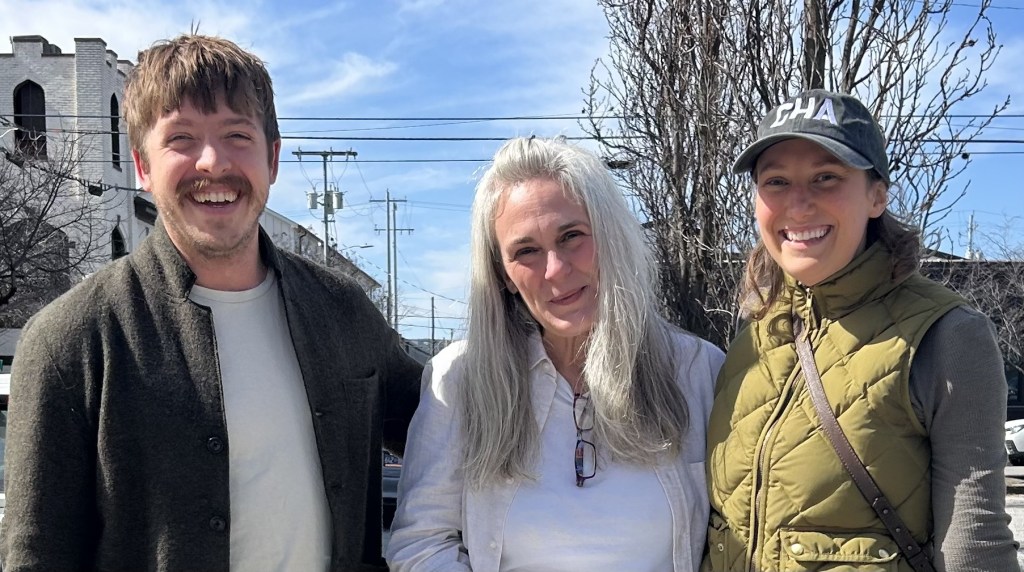
Who: Liz and Kody
Church: City Collective
Lunch: Kenny’s
Topic: What is Church and will I attend a Sunday morning service after this project
Well, I made it to the halfway mark and I’m not sure where to start. Before I began this project, I made a commitment to myself to visit my “home church” every three months to stay connected and, honestly, I miss my people. So, today I went back to City Collective and then grabbed lunch with these two humans. To say I adore them would be an understatement. I genuinely consider them to be family. Liz was there with me during the very first week of this journey, and now, as she sits beside me at the halfway mark, it only feels right that she’s there for the final week, too.
Something people might not know about our family, we don’t have a very large inner-circle. We don’t trust a lot of people, for understandable reasons. But when we do, we hold onto them tightly. The people in our inner circle aren’t just friends—they’re the ones who have walked with us through the highs and lows, who have seen the messy, unfiltered parts of our lives and stayed anyway. Because, here’s the reality: What you see is genuinely what you get with our family. We don’t put on a show, we don’t sugarcoat things, we don’t pander to the “elite”, and we don’t pretend to be something we’re not. We love deeply, we protect fiercely, and we constantly remind ourselves that authenticity matters more than approval. (And, we screw up A LOT.) We’re not here to impress the right people or fit into a mold—we’re here to live with purpose and to stand by our values.
So, as I sit at my local coffee shop reflecting on the past six months, the only thing I can think about is something I told Kody during lunch: After this year-long project is done, I’m not sure if I’ll regularly attend a Sunday morning service ever again. I know that seems like a radical, maybe even heretical, statement, but it really isn’t. Over the past six months, I’ve met some of the most extraordinary people—fellow sojourners navigating the complexities of faith. A recurring theme in our conversations has been the growing tension with how the contemporary church has embraced a business model, often prioritizing growth metrics, branding, and polished performances over genuine community, discipleship, and the raw, messy beauty of authentic faith. And one of the questions everyone seems to be asking:
If not this, then what?
I won’t even begin to unpack all of that here, but I will say this—and I can only speak for myself. For far too long, I blindly accepted what was handed to me, never questioning the traditions, the systems, or the way faith was packaged and presented. But when I finally did start asking questions—when I started holding the modern, entertainment-driven model of church up against what I saw in the book of Acts—I was met with dismissal. I was told that the kind of church described in Acts was “all but dead,” an idealistic relic of the past rather than a blueprint for today. And that response only deepened my questions: Why had we strayed so far from it? And why was there so much resistance to returning?
The next few paragraphs provide a brief yet concise overview of how the early church was formed. While not an exhaustive account, they highlight some of the key moments and foundational aspects that shaped its development:
Before 400 AD, the early church looked very different from both the formalized structure that developed later and the modern Sunday morning experience. The church was more decentralized, relational, and often underground due to persecution. Christians primarily met in homes (Romans 16:5, Acts 2:46) rather than in designated church buildings. These were small, intimate gatherings where believers shared meals, prayed, worshiped, and discussed scripture. There were no official clergy as we think of them today. Leadership was based on spiritual gifting (Ephesians 4:11–13) and often included elders (presbyters), deacons, and itinerant apostles or prophets.
As Christianity grew, certain trends began to shape a more formalized church structure. Apostles and prophets gave way to bishops (overseers) who provided stability as false teachings arose (e.g., Gnosticism). By 200 AD, bishops were central leaders in most major cities. As Christianity spread, letters and gospel accounts were shared widely. To maintain doctrinal unity, church leaders began distinguishing inspired writings from others, leading to the development of the New Testament canon. Worship began to include more structured prayers, creeds, and sacraments (like baptism and communion) to unify believers across different regions.
Everything changed when Emperor Constantine legalized Christianity in 313 AD (Edict of Milan). Within a century, Christianity went from an outlawed faith to the dominant religion of the Roman Empire. Instead of meeting in homes, Christians began worshiping in basilicas (Roman public buildings repurposed as churches). Bishops gained more authority, eventually leading to the rise of the papacy in Rome. The church became intertwined with the state. By 380 AD, Emperor Theodosius made Christianity the official state religion (Edict of Thessalonica), enforcing doctrinal unity. To settle theological disputes, church leaders convened councils (e.g., Nicaea in 325 AD, Constantinople in 381 AD), establishing foundational Christian doctrines like the Trinity.
At the end of the day, I think the formalized structure was created for three reasons: to combat heresy, to maintain order, and to gain legitimacy. (This does not take into account any nefarious agendas.) But, when the church transitioned from a decentralized, organic movement to an institutionalized structure, several key aspects of early Christianity were diminished or lost:
- Intimate, Relational Community → Replaced by Large, Institutional Gatherings
- The early church thrived in small, house-based gatherings where believers shared life together, breaking bread, confessing struggles, and supporting one another.
- As church buildings and formalized services took over, faith became more about attendance rather than participation, leading to a loss of deep, personal relationships.
- Spirit-Led, Participatory Worship → Replaced by Spectator-Based Services
- In the first-century church, everyone could bring something to the gathering—songs, teachings, prophecies (1 Corinthians 14:26).
- Over time, worship became structured, performance-driven, and clergy-led, making most people passive observers rather than active participants.
- Radical Generosity & Shared Resources → Replaced by Institutional Funding Models
- The early church lived out radical generosity, sharing all things in common (Acts 2:44-45).
- When Christianity became the state religion, financial giving was redirected toward maintaining church buildings, clergy salaries, and institutional programs, rather than directly supporting those in need.
- Mission & Discipleship → Replaced by Doctrine & Authority Structures
- Originally, Christianity spread through discipleship and personal witness, with ordinary believers carrying the gospel wherever they went.
- As the church formalized, hierarchical leadership and doctrinal enforcement became the focus, shifting the emphasis from making disciples to maintaining theological orthodoxy.
- Countercultural Kingdom Mindset → Replaced by Political & Cultural Alignment
- Early Christians were outsiders, often persecuted because their faith clashed with the Roman Empire’s values.
- When Christianity became a state-sponsored religion (4th century), it gained power and influence—but at the cost of its radical, countercultural nature. The church started aligning with political structures rather than challenging them.
Again, this isn’t an exhaustive list, and it’s definitely an oversimplification of some deeply complex historical shifts. However, it highlights key ways in which the early church evolved—and, in some cases, drifted from its original intent. The goal isn’t to romanticize the past but to recognize where we may have lost something valuable and consider how we can reclaim the heart of authentic, transformative faith today.
So, as I begin the second half of this journey, here are a few of the things I’ll be pondering:
How Can We Recover What Was Lost?
- Rebuild Authentic Community
- Shift focus from large services to smaller, more intimate gatherings where real relationships can form.
- Emphasize discipleship over attendance, encouraging deep, personal investment in each other’s lives.
- Redirect Resources to People, Not Programs
- Focus on meeting tangible needs rather than maintaining expensive buildings or extravagant productions.
- Challenge the consumer mindset by fostering generosity and mutual support.
- Return to Grassroots Discipleship & Mission
- Equip believers to live out their faith daily instead of depending on professional clergy for spiritual growth.
- Shift from church as a place to go to church as a way of life, where discipleship happens everywhere, not just on Sundays.
- Reclaim the Church’s Prophetic Voice
- Refuse to let political and cultural power dictate the church’s message.
- Return to a radical, kingdom-centered faith that prioritizes justice, mercy, and truth over institutional preservation.
You know… easy stuff!
CHALLENGE: Spend some time thinking—and talking with others—about what you believe the church is meant to be. Is it a building? A gathering? A movement? A family? How does your understanding of church align with what you see in Scripture, especially in the book of Acts?
Then, take it a step further: If you could strip away tradition, expectations, and modern structures, what would the church look like in its purest form? And what small steps can you take to live that out in your own community?
 Searching for Jesus in A̶m̶e̶r̶i̶c̶a̶ Chattanooga