
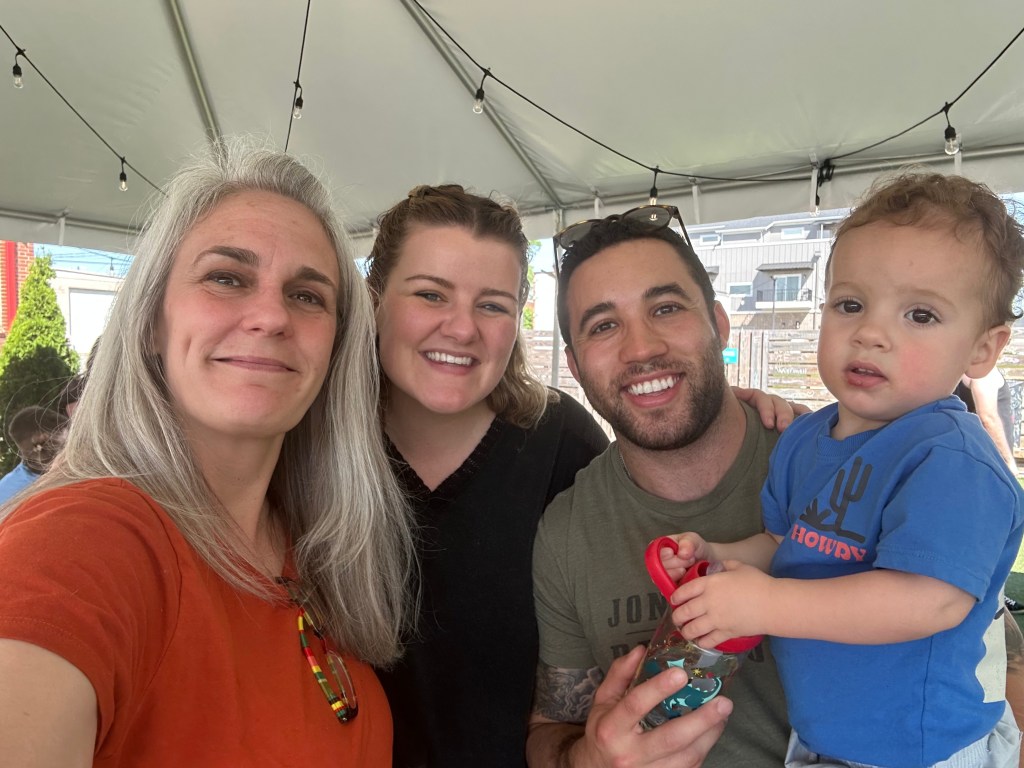
Who: Sarah and Nate
Church: Citizens of Heaven
Lunch: Oddstory
Topic: Great Hermeneutics and Exegesis… and a Willingness to Go Deep
This week is one where the connections run deep and where the personal and professional cross over… a few times. I met Sarah a year after we moved to Chattanooga and at the time she was working for Mental Health Association of East Tennessee. One of our very first projects together was a seven month labor of love that had us looking at the role of the Church when it comes to the mental health crisis facing our youth.
I could probably write five separate posts about this endeavor, but here’s the short version:
A while back, we tried to gather a group of local youth pastors for monthly conversations about the complex role churches play—both for better and worse—when it comes to the mental health of the young people in their care. Our hope was to create a space for honest dialogue and shared learning, where we could bring in community members with deep lived experience and professional insight—counselors, crisis responders, advocates—people who understood both the systemic challenges and the quiet suffering so many teens endure.
The meetings were co-facilitated by me, Sarah, and our friend Chris, who formerly worked with the Tennessee Suicide Prevention Network. All of us are Christians bringing invaluable perspectives, particularly around the intersection of faith and crisis prevention.
But here’s the hard truth: getting church leaders to attend was nearly impossible.
We heard all kinds of reasons—scheduling conflicts, theological differences, and, at times, just silence. But perhaps the most disheartening barrier was the deep division among some church leaders themselves. In more than one conversation, I felt like I was back in middle school—navigating cliques and rivalries, rather than a shared commitment to serve the young people in our community. It was a stark reminder that ego and turf wars can often get in the way of real, collaborative ministry. But one conversation still haunts me. A pastor with a congregation of over 1,000 people told us, point-blank, that his church “didn’t have a mental health problem.”
Statistically, that’s not just unlikely—it’s impossible.
When 1 in 5 teens experiences a mental health disorder and suicide remains a leading cause of death among young people, the idea that any large group of people—let alone an entire church—would be immune is dangerously naive. And when leaders dismiss the reality their youth are living, they’re not only failing to support them—they’re helping perpetuate the silence and stigma that keep kids from getting help in the first place.
This work is hard. But we keep showing up because we believe faith communities can and should be part of the healing process. And we’re not done trying.
I’m going to circle back to this in a moment—because it directly connects to the work our family is committed to. But more than that, it represents an incredible opportunity for the Church—not just to show up in name, but to step into the kind of transformational work that reflects the heart of the Gospel. It’s a chance to reimagine what it looks like to build relationships, meet tangible needs, and stand in the gaps where systems have failed. And if we’re willing to lean in, the impact could be both immediate and lasting.
So what were my takeaways from Citizens of Heaven?
I’m extremely hesitant to make a list of things I like (or don’t like) about any church. That has never been the goal of this project, and it still isn’t. This isn’t about personal preferences—musical styles, preaching formats, or whether there’s coffee in the lobby. Those things are surface-level. What I’m paying attention to—what this journey is about—is how communities live out their values: how they care for people, how they respond to brokenness, how they make space for those who’ve been left out or hurt. So while I may mention things I appreciated, it’s not to score points or make comparisons. It’s to highlight the ways a faith community’s posture can reflect the heart of Jesus. And in this case, there are some specific ways this church’s leadership and approach have done just that—and they’re worth naming.
One of the things I really need—and honestly feel compelled—to talk about is hermeneutics and exegesis. Not in some academic, ivory tower way, but because how we interpret Scripture matters deeply in the life of the Church and in the lives of the people we’re trying to love and serve. The lens we bring to the Bible—our hermeneutic—shapes what we see and don’t see. And our exegesis, the way we draw meaning from the text, has a direct impact on how we teach, how we lead, and how we show up in the world. When Scripture is handled responsibly, it can bring healing, challenge systems of injustice, and call us toward radical love. But when it’s used carelessly, or through a lens of power, fear, or cultural bias, it can do real harm.
So when I visit churches or listen to sermons, It’s not about whether the speaker is dynamic or the message is polished. I’m listening for how the text is being handled. Are we digging into context? Are we asking hard questions? Are we letting Scripture disrupt us, or are we using it to justify what we already believe? These are the kinds of questions that matter to me.
And, for the first time in a long time, I felt like I was back in seminary. For some, that might sound like a turn-off—like the sermon was going to be too intellectual, too dense, or disconnected from everyday life. But it shouldn’t be. And here’s why:
A gifted preacher doesn’t preach at people from an academic pedestal. They know how to meet people where they are, whether someone is walking through the door for the first time in years or has been studying theology for decades. They’re able to hold both the surface and the depth—offering something that is immediately accessible while also inviting people to go further, to wrestle, to dig into the tension and richness of Scripture.
That’s what good preaching does: it doesn’t water anything down, but it also doesn’t shame people for not knowing everything. It creates space for curiosity. It says, “You don’t have to have a degree to understand this—but if you do want to go deeper, there’s room for that, too.”
That’s what I felt for the first time in a long while: like I was being challenged and fed—not just emotionally, but intellectually and spiritually. And I think we need more of that in the Church today. Because when we honor people’s capacity to think deeply and feel deeply, we’re honoring the full complexity of who God made us to be.
I also want to mention that Citizens of Heaven just kicked off a new sermon series on the Gospel of John. Now, I’ll be honest—John isn’t my favorite book of the Bible (that title goes to James… feel free to psychoanalyze that however you want). But it does contain my absolute favorite passage: John 17:20–23.
I naturally lean toward the ESV for most of my reading, but the NIV’s interpretation of this particular passage has always stuck with me. And I’m genuinely looking forward to seeing how their pastor unpacks these three verses when the time comes.
That said… it might take a little while to get there. This past Sunday, he made it through just a few verses. (As someone who once spent two years walking a group of 20-somethings through the book of Romans, I have nothing but respect for that kind of deep dive.) And honestly? I’m here for it. Bring on the slow, intentional walk through Scripture.
Their pastor also spent time sharing parts of his own mental health journey—a moment that stood out not only for its vulnerability but also for how rare it is to hear from the pulpit. In my experience, pastors are often expected to carry the weight of spiritual leadership with an almost superhuman level of emotional control. But when a pastor openly names their struggles—whether with anxiety, depression, burnout, or anything else—it disrupts that false narrative and gives others permission to be human, too. It models emotional honesty, reduces stigma, and reminds the congregation that faith and mental health are not at odds. In a time when so many are quietly carrying emotional burdens, his willingness to speak openly created space for connection, healing, and grace.
My experience at Citizens of Heaven, juxtaposed against the experiences mentioned at the beginning of this post, reveals a stark and sobering contrast. In many of the spaces we’ve stepped into—especially when visiting churches or seeking collaboration for community work for BTCYI—we’ve often been met with hesitation, defensiveness, or even outright dismissal. Whether it’s theological rigidity, personality politics, or simply a reluctance to partner outside of one’s own circle, the result is the same: closed doors and missed opportunities for meaningful connection.
But Citizens of Heaven felt different. There was a sense of humility in the way they approached their leadership, a willingness to be vulnerable, and a genuine openness to engaging people where they are. Instead of posturing or presenting a perfectly polished image, they embraced authenticity—and in doing so, made space for others to do the same.
This contrast matters. Because it shows what’s possible when a faith community leads with grace instead of ego, hospitality instead of hierarchy, and curiosity instead of control. It’s the difference between gatekeeping and bridge-building. And in a world—and a Church—where so many are feeling disillusioned or displaced, that difference could not be more important.
 Searching for Jesus in A̶m̶e̶r̶i̶c̶a̶ Chattanooga