
Who: Katherine
Church: Wellington Church (Church of Scotland)
Lunch: Snacks in he fellowship hall
Topic: Unity and Outreach
A few weeks ago, I traveled to Scotland to drop my youngest daughter off at the University of Glasgow. While there, I decided to attend a local church service, curious to experience faith in a different cultural context. That same week, news broke in the United States of the unexpected death of someone I’ve written about repeatedly over the past five years. The shockwaves from his murder were felt across the pond, and the fallout from this was the topic of many conversations.
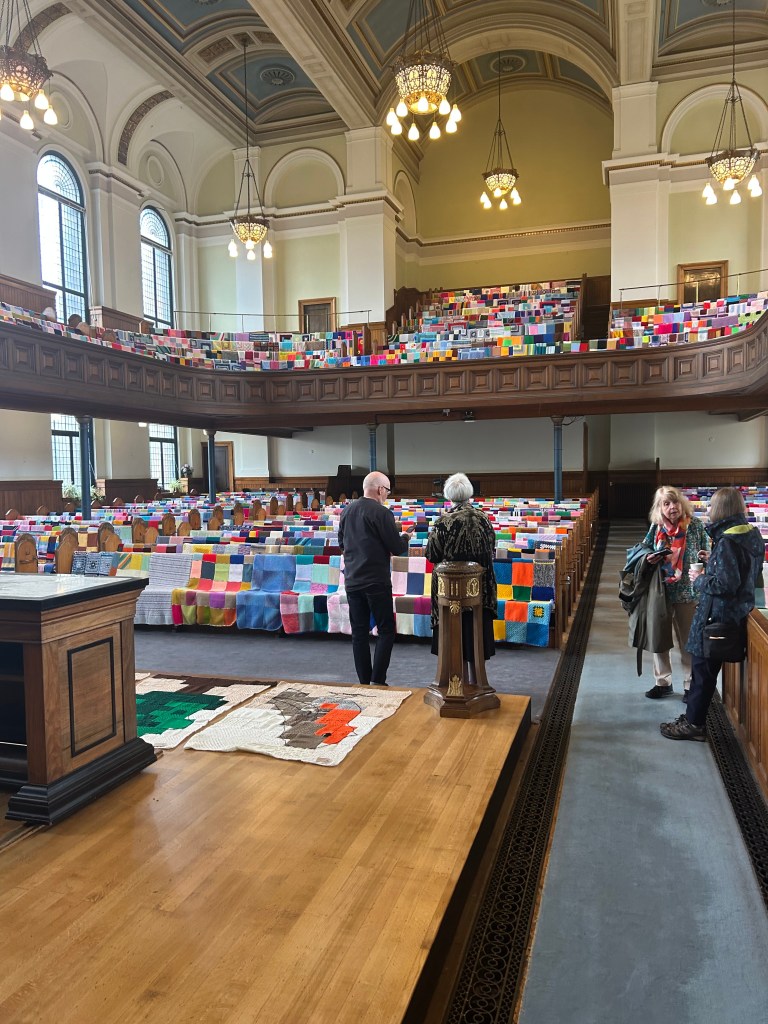
Truth be told, I’m grateful to have been in the UK as the news of Charlie Kirk’s death spread. But even more than that, I’m grateful to have been with these people, standing in a church literally filled with love in the form of blankets.
For a year, people across Scotland had been crocheting squares, one by one, stitch by stitch, each piece carrying the care and compassion of the hands that made it. And now, here it was: a sea of color and warmth, woven together into something far bigger than any one person. What began as a simple project had become a beautiful testament to what happens when kindness takes root, a reminder that love, in its purest form, doesn’t need a platform or a headline. It just needs people willing to pick up a thread and begin.
But, as the days went on, I found myself increasingly alarmed, and honestly, agitated, by what I was seeing unfold in the United States. And before I type another word, I think it’s important to pause and name something that feels central to all of it: cognitive dissonance.
Cognitive dissonance is that inner tension we feel when our beliefs and our actions don’t align. It’s the discomfort that comes from holding two conflicting ideas at once, like claiming to love your neighbor while supporting systems, or rhetoric, that harm them. Rather than confronting that tension, many people try to explain it away, justify it, or ignore it altogether.
And then there’s gaslighting, a psychological tactic that involves manipulating someone into questioning their own reality, memory, or perception of truth. It’s a powerful tool of control, and sadly, it’s become one of the most common strategies used within the growing movement of Christian Nationalism.
At its core, Christian Nationalism blurs the line between faith and political ideology. It wraps nationalism in the language of religion, convincing people that defending a political agenda is the same as defending God. The result is a distortion of both faith and truth—a movement that leaves many sincere Christians confused, fearful, and divided.
I’ve spent the past month thinking and reflecting on what happened in the days and weeks after Kirk’s death… what’s still happening.
The fallout from Charlie Kirk’s public statements, particularly his most exploitative remarks about women, Muslims, and people of color, can be understood through the twin lenses of cognitive dissonance and gaslighting.
For many who have followed him, cognitive dissonance shows up as the mental conflict between what they’ve been taught about Jesus’ message of love, humility, and justice, and what they’re now being told under the banner of “Christian values.” (One of the most shocking realities for me in the days and weeks since his death has been seeing how many people were unaware of his most caustic, dehumanizing, and un-Christ-like stances.) When a public figure claims to represent Christ while speaking words that demean, or divide, it creates a deep internal tension. Rather than confronting that contradiction, some choose the easier path, defending the messenger instead of questioning the message. Over time, that dissonance dulls empathy and normalizes hostility toward groups that the Gospel calls us to embrace.
Then comes gaslighting, a tactic that keeps people confused and compliant. Kirk and others in his sphere often reframe criticism as persecution, suggesting that any pushback is an attack on Christianity itself. They twist facts, redefine language, and paint those who challenge them as “anti-faith” or “un-American.” This manipulative narrative causes followers to doubt their own moral intuition and makes them more dependent on the leader’s version of truth.
Together, these dynamics have produced a kind of moral disorientation in parts of the American church. The result isn’t just political polarization, it’s spiritual confusion. Many are left believing they’re defending their faith, when in reality, they’re defending an ideology that weaponizes it.
We find ourselves in an unfortunate circumstance when it comes to the Church in America… but, please understand that it isn’t limited to America. And while most of our attention is centered around politics, the truth is that it needs to be centered around Jesus and the reality that he would never align himself with a political movement.
Unless it was based on feeding the hungry, sheltering the sojourner, welcoming the marginalized, and loving our neighbors without agenda, it would be a betrayal of everything Jesus stood for.
The church I visited in Scotland had a congregation made up of various ethnicities and no generational chasm. The service was antithetical to the performative structure so many churches adopt in the States. It was simple.
Almost like Jesus was enough.
And maybe that’s the point.
 Searching for Jesus in A̶m̶e̶r̶i̶c̶a̶ Chattanooga