
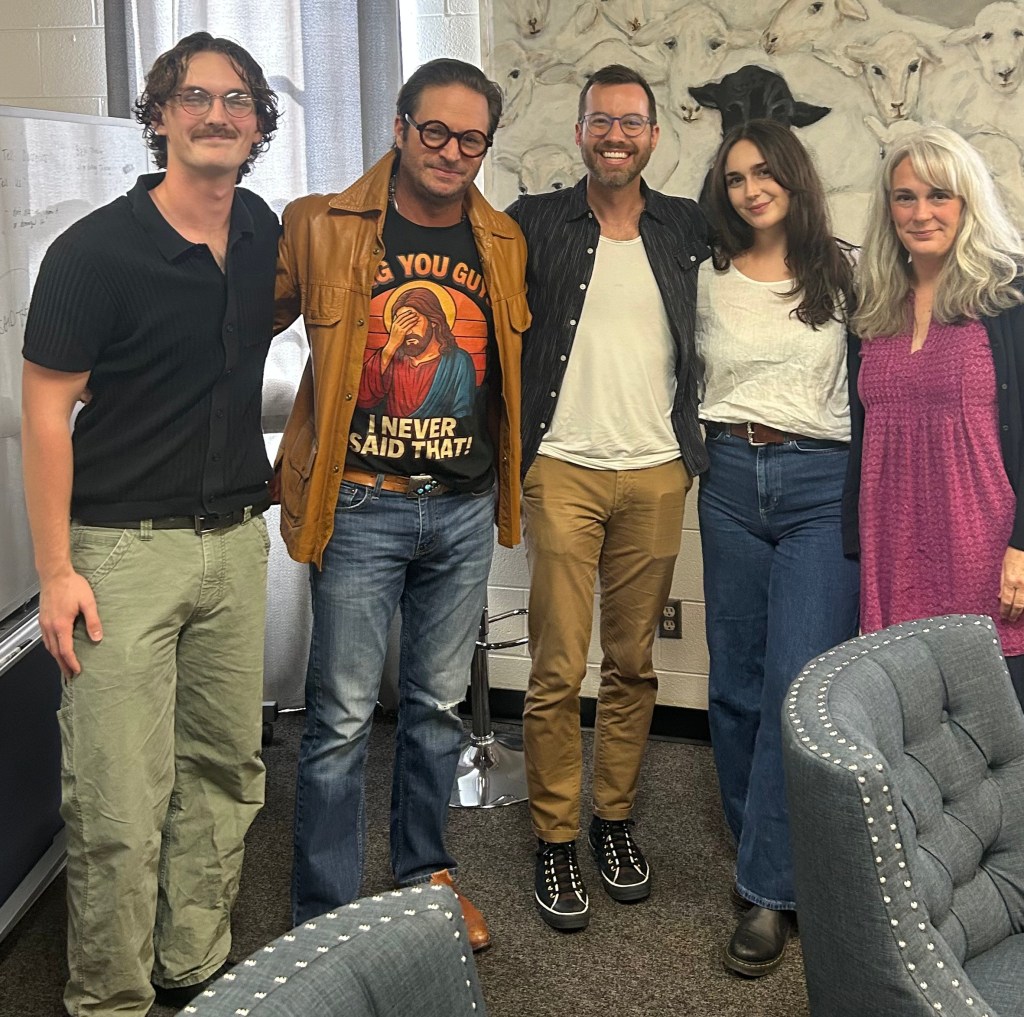
Who: Jason and Mark
Church: Austin New Church
Lunch: Pinthouse Pizza
Topic: A Better Way Forward
This photo tells a story, six years in the making.
To truly understand that story, we have to go back to one of the most painful seasons of my life. Many people know the origin story of Be The Change Youth Initiative: a movement born out of a series of deeply unfortunate circumstances marked by misogyny and profoundly unhealthy leadership within the church. But what most don’t realize is that another story was unfolding at the same time, one that, looking back, could only have happened because our family made the difficult decision to physically remove ourselves from our home in Maine… from our community, our comfort, and everything familiar.
But maybe the story begins even earlier than that.
Thirteen years ago, I experienced my first real confrontation with the inconsistencies of the modern evangelical church. I remember opening the Book of Acts and asking what felt like such a simple question: Why isn’t this the church we’re striving to be? Why have we traded authenticity for performance, and community for comfort? Why are we so quick to protect our image rather than pursue the radical simplicity of caring for the marginalized, as the early church did?
The answer I received from one of the elders has stayed with me all these years:
“The church in Acts is all but dead.”
At the time, those words devastated me. But now, I see that moment as the beginning of a long journey, one that continues to shape who I am and why I do what I do today.
Fast forward to when we left Maine.
At the time, I was finishing my Master’s in Biblical and Theological Studies at Dallas Theological Seminary. (That detail will become important a little later in the story.) Over the course of just a few years, our family had been part of four different churches. And before I go any further, I want to be clear, this wasn’t church hopping. One of those churches was the one we helped plant in Rhode Island.
But the others… they became the source of some of the deepest church-related wounds my family has ever experienced, wounds that, even now, haven’t fully healed.
There was the church that refused to meet with us when our son began struggling with depression, instead directing us to the Focus on the Family website for help. There was another where the youth pastor actively discouraged students from helping Sydney raise funds for Make-A-Wish America, an act that led to six long months of so-called “mediation.” During that process, the same youth pastor told my husband he needed to “get his wife in line” and “remind her to be submissive.” And then there was the church whose pastor grew so enraged after I confronted him about his hypocrisy, something he had explicitly invited me to do, that Sydney had to physically step between us because she thought he might become physically aggressive.
So, when we decided to leave Maine and begin our cross-country adventure, our family made a very intentional choice: We would visit a different church every Sunday, regardless of denomination. We wanted to experience the breadth of the Christian faith in America, to see how different communities worshiped, taught, and lived out their beliefs. It wasn’t about finding a “perfect” church; it was about understanding the diversity within the body of Christ and recognizing both the beauty and the brokenness that exists across traditions. Each week became an opportunity to learn… about theology, culture, and the ways people interpret what it means to follow Jesus in their own context.
And to be completely transparent… the way those non-denominational churches treated women made me curious and increasingly uneasy. At the time, I still believed in a complementarian framework, one that emphasized different roles for men and women within the church and home. I genuinely thought those boundaries were biblical and even beautiful when lived out with humility and mutual respect. But what I began to see was something else entirely.
Instead of men using their positions to serve and uplift, I saw power being used to silence, to control, and to diminish women’s voices. Decisions were made behind closed doors, leadership teams were entirely male, and women who asked hard questions were often labeled as divisive or rebellious. The language of “spiritual leadership” became a shield for ego and dominance.
So, while I still held to the idea that men and women might have distinct roles, I could no longer ignore how those teachings were being twisted into tools of manipulation. What was supposed to reflect Christ’s love and sacrifice had turned into a system that protected authority rather than people. That tension, between what I believed and what I witnessed, is what first made me start asking deeper questions about how we interpret Scripture, power, and equality in the church.
But, it was a process.
So fast forward when we reached Austin and all my friends were curious if we would visit Austin New Church. For the sake of time, I’ll give you the short version: this church had a reputation for being progressive, open, and affirming, three adjectives that, at the time, absolutely no one would have used to describe me or my faith. The first few times someone suggested it, I laughed it off, certain that it wasn’t my kind of place. But after the tenth time or so, I began to wonder if maybe there was something I was supposed to see there.
So, we went.
But to be completely honest, my motives weren’t pure. I walked into that church with a critical spirit, ready to pick apart every lyric, every line of theology. I was looking for any reason to prove that my assumptions about “churches like that” were right. But I couldn’t find one. In fact, a few weeks later, curiosity got the best of me, and I went back online to listen to the sermons from the week before and the week after the one we attended. And here’s the thing—I’m convinced that if we had gone on either of those Sundays, I would’ve stormed right out, self-righteous and indignant, still convinced of my own correctness. But we didn’t. And that single twist of timing changed everything.
(To be continued…)
 Searching for Jesus in A̶m̶e̶r̶i̶c̶a̶ Chattanooga