Week 52: The Year Is Over, So What Did I Learn?

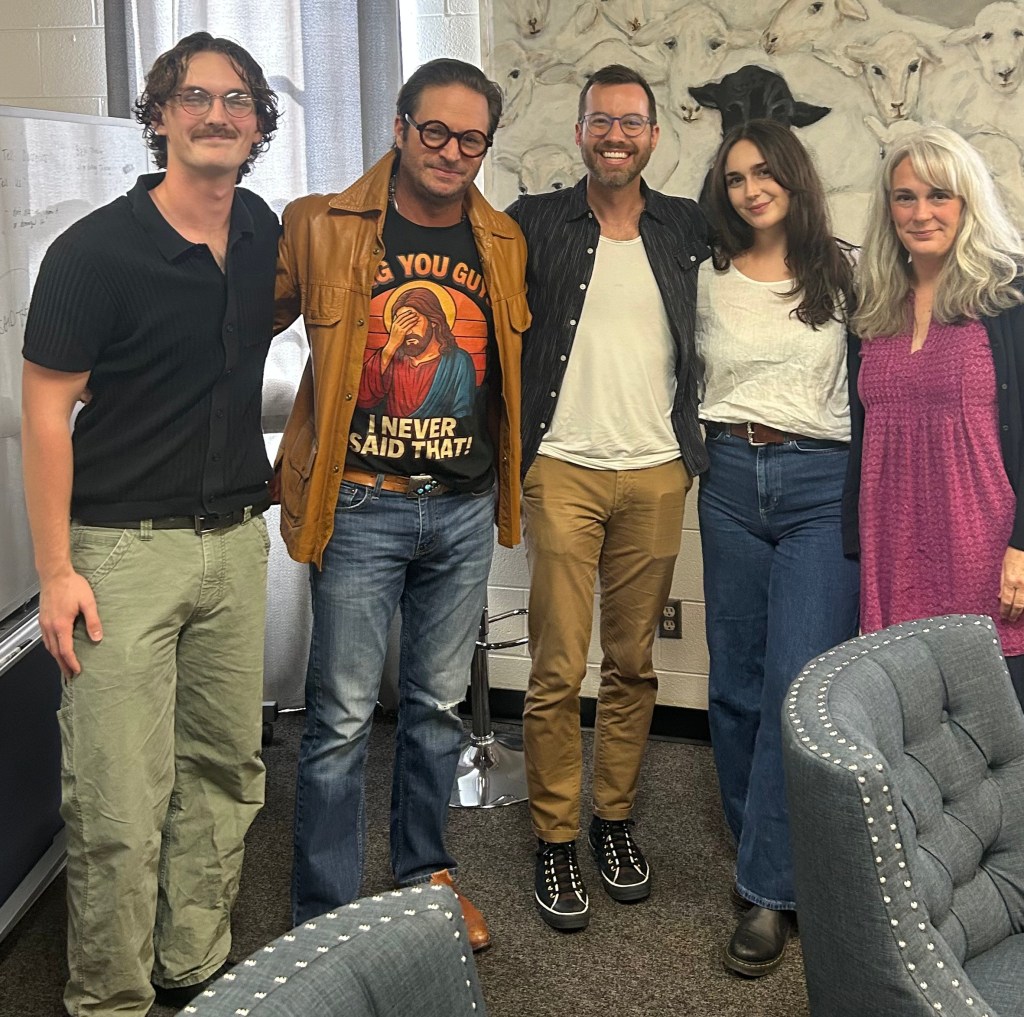
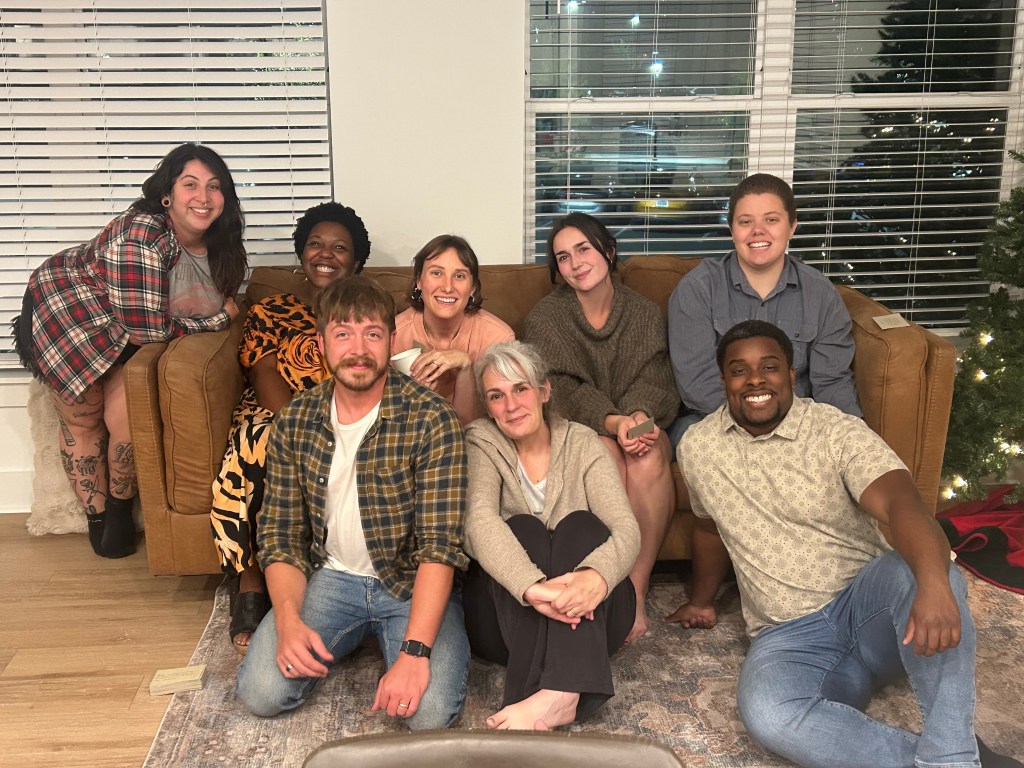
Who: Sunny, Nneka, Liz, Kody, Sydney, Payton, Justin and Jamie (not pictured)

Church: Literally…US

Dinner: My apartment

Topic: A Year in Review and What’s Next

While I was in Austin, it struck me that I was officially rounding out my year of visiting churches in Chattanooga. The realization settled in slowly, but once it did, I felt this unexpected wave of tenderness toward the experience, like reaching the end of a long, meaningful conversation you don’t quite want to leave. I instinctively wrote that I wanted to celebrate the moment, but that word didn’t feel right. Celebration suggests a loud joy, a triumphant exclamation point. What I felt was quieter, softer… a kind of sacred acknowledgment.

This year wasn’t about tallying visits or achieving a goal; it was about listening, learning, and allowing myself to be shaped by stories, communities, and the slow work of attentive presence. So instead of celebrating, I found myself wanting to commemorate it, to honor the journey and the ways it stretched me. To pause long enough to recognize the transformation, not just move on to the next thing.

This journey began with Sydney, Liz, and Nneka, three women who have shaped, challenged, and walked with me through some of the most meaningful conversations over the past few years. So it felt only right that I brought this year-long journey to a close with the same people who helped spark it.

What’s interesting, though, is how much has changed in each of us over the past twelve months. In our own ways, all four of us have taken steady steps away from the familiar structure of institutional church. Not out of bitterness, and not out of rebellion. We’ve each been experiencing what I believe to be a holy restlessness that keeps asking:

Is there more to church than what we were handed?
Is there more to following Jesus than the systems we were taught to blindly trust?

We’ve wrestled with those questions.
We’ve sat in the tension.
We’ve allowed ourselves to name what feels misaligned, and to imagine what a faith shaped by honesty, compassion, courage, and lived experience might look like.

Ending this journey with them wasn’t just sentimental.
It was symbolic.
Because in many ways, we’re all standing on the edge of something new: a faith less defined by institutions and more defined by the quiet, everyday ways we show up, love people well, and choose to keep seeking Jesus even when the path looks different than we expected.

So the invitation was simple, nothing flashy, nothing complicated:
Come over for dinner. And bring someone with you who still wants to follow Jesus but has maybe grown disillusioned with “church.”

We weren’t looking for people with polished answers or perfect faith. We were looking for the ones who are still trying, still hoping, still holding on to Jesus even as the institutional structures around them have left them confused, disappointed, or hurt. People who love the heart of the gospel, but aren’t sure where they fit anymore. It was an invitation into honesty, into community, and into the kind of table where questions and doubt aren’t liabilities.

I’m not going to rehash the conversation, because the words themselves aren’t what’s important. (Also, it was a safe space to speak honestly.) But, what is important is the larger pattern it represents—how many people are quietly disillusioned, uneasy, and, in most cases, becoming increasingly more frustrated and angry about what’s unfolding right in front of us.

And it was the following day when I realized one of the sources of my own growing anger: so many church bodies are acting like they are oblivious. As if ignoring the problem will somehow make it disappear. As if silence is a form of neutrality and not complicity. That disconnect—that refusal to engage—hit me harder than I expected. Because acknowledging what is happening, in real time around us, would require courage, accountability, and change. And far too many would rather protect their comfort than confront the truth.

But not all.

There were eight church communities I visited this year that I would genuinely consider returning to, places where I felt a spark of connection, curiosity, even belonging. In another life, maybe in another season, I could imagine our family settling into one of them, becoming part of their rhythm and their story.

But that isn’t the path we’ve been called to walk.

So where does that leave me?

I could easily write several more posts about this journey, about the moments that surprised me, the ones that disappointed me, and the ones that quietly reshaped my understanding of faith and community. But instead, I’ll offer this:

I’ve come to see the Sunday morning gathering, at its core, as a truly beautiful idea, people coming together to remember who they are, to encourage one another, to be formed by something holy and hopeful. There is purpose in that, and for many, there is life. But if I’m honest, I’ve never been a Peter.

I’m a Paul. (Yeah, the guy had issues, but you understand the comparison.)

Some people are called to build the house. Others are called to take the story on the road. Both matter. Both are faithful. Both reveal something essential about what community can be.

And I’m finally learning to stop apologizing for being the kind of person who meets God most clearly on the move.

And as I sit here in my neighborhood coffee shop, eyes blurring from tears, I’m struck again by the profound beauty of the story the Lord has entrusted my family to live. It feels almost impossible when I try to put it into words. If we weren’t the ones walking it… if these weren’t our steps, our prayers, our moments of stumbling forward… I’m not sure I’d believe it myself.

Yet here we are, somehow still moving forward.

What amazes me most is how the thread has held through every season. Every detour. Every unexpected turn. Every door that shut and every door that cracked open just enough for light to spill through. It’s only when I stop long enough to look back that I can see how intentional it all was, how the Lord has been weaving something far bigger, far more redemptive, than anything we could have designed.

And this gives me courage, because we’re walking into a chapter of our country that feels unsteady, uncertain, and heavy with things we can’t control. The air is thick with fear, division, and the temptation to retreat or harden.

But our story reminds me of something unshakeable:
Jesus is already standing in the future.
He is already where we are going.

So we will keep walking—by faith, not clarity, not certainty. We will keep showing up to the places we’re called, trusting that even in the dark, the same God who carried us here will carry us forward.

No matter what unfolds, hope is not behind us.
Hope is ahead.

Week 51: Back Where It All Began (Part 2)

I have so many thoughts and feelings about this picture. The first is that it TRULY captures how utterly exhausted we all are. (At least the three on the left!) You can see it in our faces, the kind of tired that doesn’t just come from a long week, but from years of showing up, giving everything you have, and still waking up to do it all again. The past six years have taken a lot out of us. Personally. Professionally. And honestly, those lines have always been a little blurry for us. The work we do is deeply personal, it’s not something we can easily clock out of at the end of the day. Every success, every heartbreak, every “why are we doing this again?” moment. It all runs together. But maybe that’s what this photo shows most clearly: the cost of caring deeply and the quiet resilience that comes from still standing side by side after everything.

This picture also tells another story.

Six years ago, I walked into Austin New Church with nefarious intentions, determined to find something wrong, something heretical, something that would confirm every stereotype I had already built in my head. But, to my surprise, I found none. That particular Sunday, the message wasn’t about politics or theology. It was about people. The pastor spoke about their ministry at the border, about compassion, about welcoming those seeking refuge, about love that moves beyond comfort zones and crosses boundaries. I remember sitting there, slightly disarmed, realizing that what I was witnessing wasn’t rebellion against faith.

It was faith lived out in its purest form.

And then, six years later, there I was, sitting on their stage, sharing that very story with their congregation. The irony wasn’t lost on me. To be welcomed back by the same community I once judged from a distance felt humbling, even holy. It reminded me that grace has a funny way of circling back, teaching us that transformation doesn’t always come in lightning bolts. Sometimes, it comes quietly, in the form of people who simply choose to love well.

The story I shared was one I’ve told many times before, including here. But it begs repeating, because I truly believe it’s the only way forward when it comes to where we are as a society. Six years ago, Jamie and I went to breakfast with Jason, eager to learn more about the work Austin New Church was doing at the border. We spent 90 minutes learning about the ministry and enjoying some of the best breakfast tacos I’ve ever had in my entire life… until Jason dropped a bombshell in the last five minutes of our time together.

With a wry smile, he mentioned that his denomination would likely be removing him for his decision to perform marriages for gay couples.

He went on to say that graduates of Dallas Theological Seminary (DTS) and churches like Dallas Bible Church refer to him as a heretic… and that statement landed heavier than he probably realized. For one, I graduated from Dallas Theological Seminary. And two, we just so happened to be driving to Dallas later that same day—to stay with a family who faithfully attended Dallas Bible Church.

It was a strange, almost divine irony. In the span of a few hours, we’d move from sitting across the table from a man accused of heresy to sleeping under the roof of people who might fully agree with that assessment. It was a quiet collision of worlds I once thought were firmly divided—one that forced me to reckon with what I really believed about faith, conviction, and who gets labeled “heretic” in the first place.

But, there was one thing I was certain of: I couldn’t dismiss the REAL fruit I saw in Jason and the work he was doing.

That evening in Dallas, we shared our experience at Austin New Church with a family from Dallas Bible Church. Their response was telling. They seemed genuinely perplexed, perhaps even unsettled, that we would attend a service there, let alone spend time with Jason. Their faces said everything before their words did. Confusion. Discomfort. Maybe even a little disgust. They couldn’t understand why we would step foot in a place like ANC, let alone share a meal with its pastor. That reaction stayed with me, because it revealed something deeper than theological disagreement.

It exposed a fear of proximity.

A couple of days later, I reached out to Jason. I told him I sensed God was about to lead me on a journey, and that I’d be grateful to have him as someone I could process things with—to ask questions, wrestle honestly, and maybe find some guidance along the way. His response was short and direct. He declined. (And, to be fair, I didn’t blame him.)

But a couple of day later, he circled back and said that he’d had a change of heart. Maybe he felt guilty, but I seriously doubt that was the case. Maybe he was curious. Maybe it was half a dozen other reasons. I’ve never asked him and, at the end of the day, it doesn’t matter. But I can tell you that having that connection, that sounding board, was pivotal to my faith journey. There are moments from living on the road, seared into my brain, like the time I spent 30 minutes pacing in between rows of RV’s at a camp ground near the Montana and Canadian boarder. I was questioning so many things I had been taught through the patriarchal lens of scripture, pulling threads that would lead to unraveling.

Circling gravel loops under a cold sky, wrestling with questions I had never allowed myself to ask before. Those theological threads, woven through a lifetime of teaching, I could feel them loosening, one by one. It was terrifying and liberating all at once. That unraveling wasn’t the end of my faith; it was the honest beginning of it.

Going back to Austin was healing.

Being away from Chattanooga was needed.

And now that we’re back, it’s time to get to work.

Week 51: Back Where It All Began (Part 1)

Who: Jason and Mark

Church: Austin New Church

Lunch: Pinthouse Pizza

Topic: A Better Way Forward

This photo tells a story, six years in the making.

To truly understand that story, we have to go back to one of the most painful seasons of my life. Many people know the origin story of Be The Change Youth Initiative: a movement born out of a series of deeply unfortunate circumstances marked by misogyny and profoundly unhealthy leadership within the church. But what most don’t realize is that another story was unfolding at the same time, one that, looking back, could only have happened because our family made the difficult decision to physically remove ourselves from our home in Maine… from our community, our comfort, and everything familiar.

But maybe the story begins even earlier than that.

Thirteen years ago, I experienced my first real confrontation with the inconsistencies of the modern evangelical church. I remember opening the Book of Acts and asking what felt like such a simple question: Why isn’t this the church we’re striving to be? Why have we traded authenticity for performance, and community for comfort? Why are we so quick to protect our image rather than pursue the radical simplicity of caring for the marginalized, as the early church did?

The answer I received from one of the elders has stayed with me all these years:
“The church in Acts is all but dead.”

At the time, those words devastated me. But now, I see that moment as the beginning of a long journey, one that continues to shape who I am and why I do what I do today.

Fast forward to when we left Maine.

At the time, I was finishing my Master’s in Biblical and Theological Studies at Dallas Theological Seminary. (That detail will become important a little later in the story.) Over the course of just a few years, our family had been part of four different churches. And before I go any further, I want to be clear, this wasn’t church hopping. One of those churches was the one we helped plant in Rhode Island.

But the others… they became the source of some of the deepest church-related wounds my family has ever experienced, wounds that, even now, haven’t fully healed.

There was the church that refused to meet with us when our son began struggling with depression, instead directing us to the Focus on the Family website for help. There was another where the youth pastor actively discouraged students from helping Sydney raise funds for Make-A-Wish America, an act that led to six long months of so-called “mediation.” During that process, the same youth pastor told my husband he needed to “get his wife in line” and “remind her to be submissive.” And then there was the church whose pastor grew so enraged after I confronted him about his hypocrisy, something he had explicitly invited me to do, that Sydney had to physically step between us because she thought he might become physically aggressive.

So, when we decided to leave Maine and begin our cross-country adventure, our family made a very intentional choice: We would visit a different church every Sunday, regardless of denomination. We wanted to experience the breadth of the Christian faith in America, to see how different communities worshiped, taught, and lived out their beliefs. It wasn’t about finding a “perfect” church; it was about understanding the diversity within the body of Christ and recognizing both the beauty and the brokenness that exists across traditions. Each week became an opportunity to learn… about theology, culture, and the ways people interpret what it means to follow Jesus in their own context.

And to be completely transparent… the way those non-denominational churches treated women made me curious and increasingly uneasy. At the time, I still believed in a complementarian framework, one that emphasized different roles for men and women within the church and home. I genuinely thought those boundaries were biblical and even beautiful when lived out with humility and mutual respect. But what I began to see was something else entirely.

Instead of men using their positions to serve and uplift, I saw power being used to silence, to control, and to diminish women’s voices. Decisions were made behind closed doors, leadership teams were entirely male, and women who asked hard questions were often labeled as divisive or rebellious. The language of “spiritual leadership” became a shield for ego and dominance.

So, while I still held to the idea that men and women might have distinct roles, I could no longer ignore how those teachings were being twisted into tools of manipulation. What was supposed to reflect Christ’s love and sacrifice had turned into a system that protected authority rather than people. That tension, between what I believed and what I witnessed, is what first made me start asking deeper questions about how we interpret Scripture, power, and equality in the church.

But, it was a process.

So fast forward when we reached Austin and all my friends were curious if we would visit Austin New Church. For the sake of time, I’ll give you the short version: this church had a reputation for being progressive, open, and affirming, three adjectives that, at the time, absolutely no one would have used to describe me or my faith. The first few times someone suggested it, I laughed it off, certain that it wasn’t my kind of place. But after the tenth time or so, I began to wonder if maybe there was something I was supposed to see there.

So, we went.

But to be completely honest, my motives weren’t pure. I walked into that church with a critical spirit, ready to pick apart every lyric, every line of theology. I was looking for any reason to prove that my assumptions about “churches like that” were right. But I couldn’t find one. In fact, a few weeks later, curiosity got the best of me, and I went back online to listen to the sermons from the week before and the week after the one we attended. And here’s the thing—I’m convinced that if we had gone on either of those Sundays, I would’ve stormed right out, self-righteous and indignant, still convinced of my own correctness. But we didn’t. And that single twist of timing changed everything.

(To be continued…)

Week 50: Church in Scotland

Who: Katherine

Church: Wellington Church (Church of Scotland)

Lunch: Snacks in he fellowship hall

Topic: Unity and Outreach

A few weeks ago, I traveled to Scotland to drop my youngest daughter off at the University of Glasgow. While there, I decided to attend a local church service, curious to experience faith in a different cultural context. That same week, news broke in the United States of the unexpected death of someone I’ve written about repeatedly over the past five years. The shockwaves from his murder were felt across the pond, and the fallout from this was the topic of many conversations.

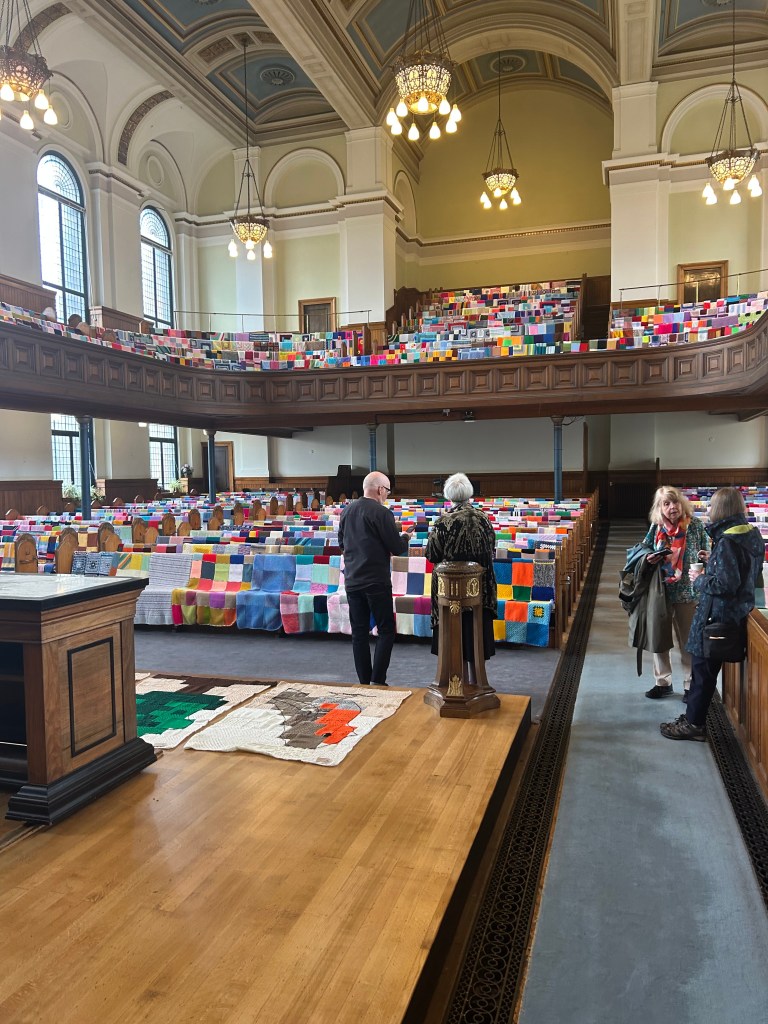
Truth be told, I’m grateful to have been in the UK as the news of Charlie Kirk’s death spread. But even more than that, I’m grateful to have been with these people, standing in a church literally filled with love in the form of blankets.

For a year, people across Scotland had been crocheting squares, one by one, stitch by stitch, each piece carrying the care and compassion of the hands that made it. And now, here it was: a sea of color and warmth, woven together into something far bigger than any one person. What began as a simple project had become a beautiful testament to what happens when kindness takes root, a reminder that love, in its purest form, doesn’t need a platform or a headline. It just needs people willing to pick up a thread and begin.

But, as the days went on, I found myself increasingly alarmed, and honestly, agitated, by what I was seeing unfold in the United States. And before I type another word, I think it’s important to pause and name something that feels central to all of it: cognitive dissonance.

Cognitive dissonance is that inner tension we feel when our beliefs and our actions don’t align. It’s the discomfort that comes from holding two conflicting ideas at once, like claiming to love your neighbor while supporting systems, or rhetoric, that harm them. Rather than confronting that tension, many people try to explain it away, justify it, or ignore it altogether.

And then there’s gaslighting, a psychological tactic that involves manipulating someone into questioning their own reality, memory, or perception of truth. It’s a powerful tool of control, and sadly, it’s become one of the most common strategies used within the growing movement of Christian Nationalism.

At its core, Christian Nationalism blurs the line between faith and political ideology. It wraps nationalism in the language of religion, convincing people that defending a political agenda is the same as defending God. The result is a distortion of both faith and truth—a movement that leaves many sincere Christians confused, fearful, and divided.

I’ve spent the past month thinking and reflecting on what happened in the days and weeks after Kirk’s death… what’s still happening.

The fallout from Charlie Kirk’s public statements, particularly his most exploitative remarks about women, Muslims, and people of color, can be understood through the twin lenses of cognitive dissonance and gaslighting.

For many who have followed him, cognitive dissonance shows up as the mental conflict between what they’ve been taught about Jesus’ message of love, humility, and justice, and what they’re now being told under the banner of “Christian values.” (One of the most shocking realities for me in the days and weeks since his death has been seeing how many people were unaware of his most caustic, dehumanizing, and un-Christ-like stances.) When a public figure claims to represent Christ while speaking words that demean, or divide, it creates a deep internal tension. Rather than confronting that contradiction, some choose the easier path, defending the messenger instead of questioning the message. Over time, that dissonance dulls empathy and normalizes hostility toward groups that the Gospel calls us to embrace.

Then comes gaslighting, a tactic that keeps people confused and compliant. Kirk and others in his sphere often reframe criticism as persecution, suggesting that any pushback is an attack on Christianity itself. They twist facts, redefine language, and paint those who challenge them as “anti-faith” or “un-American.” This manipulative narrative causes followers to doubt their own moral intuition and makes them more dependent on the leader’s version of truth.

Together, these dynamics have produced a kind of moral disorientation in parts of the American church. The result isn’t just political polarization, it’s spiritual confusion. Many are left believing they’re defending their faith, when in reality, they’re defending an ideology that weaponizes it.

We find ourselves in an unfortunate circumstance when it comes to the Church in America… but, please understand that it isn’t limited to America. And while most of our attention is centered around politics, the truth is that it needs to be centered around Jesus and the reality that he would never align himself with a political movement.

Unless it was based on feeding the hungry, sheltering the sojourner, welcoming the marginalized, and loving our neighbors without agenda, it would be a betrayal of everything Jesus stood for.

The church I visited in Scotland had a congregation made up of various ethnicities and no generational chasm. The service was antithetical to the performative structure so many churches adopt in the States. It was simple.

Almost like Jesus was enough.

And maybe that’s the point.

Week 49: A Church Beyond the Walls

Who: Mark

Church: Bridge City Church

Lunch: Church Potluck

Topic: A Church IN the Community

When I started this project over a year ago, the motivation came from a simple observation: two very different types of people seemed drawn to our work in the community—those who had left the church, and non-profit leaders with a deep love and faith in Jesus. At first glance, it felt strange, even contradictory. But the more time I spent listening, the more I realized that both groups shared something profound in common: a desire to engage honestly with hard questions, to show up for others, and to build something bigger than themselves. One group brought the perspective of disillusionment, of searching for meaning outside traditional structures. The other brought a grounded faith and a commitment to serve flowing from that belief. Together, their presence around the same table told me we were onto something important—creating a space where seemingly opposite experiences could coexist, learn from each other, and work together toward the common good.

My invitation to Bridge City wasn’t formal—it was self-imposed. My dear friend Mark, who serves as the Executive Director of one of our nonprofit partners, Corner Evolution, has spent the past year sharing story after story about his church community. Every time we talked, Bridge City came up—not just in passing, but as a place that clearly shaped the way he leads and lives. In fact, Corner Evolution itself is deeply rooted in the values of this congregation, carrying forward its spirit of compassion, service, and justice into the broader community. After hearing Mark’s reflections so many times, I finally realized I needed to see this place for myself. What I found was more than a church; it was a community that not only supports its own members but also pours out its energy and resources into the city around it.

The church is unassuming. No large signs. No reverberation of bass flowing through your body as you approach the building. No greeter with Mickey Mouse hands waving at you or a bookstore prominently places at the entrance/exit, like most of the rides at Disney. (If you’re new here, this is a not-so-subtle- jab at a few churches I’ve visited over the years.)

But, here’s what it did have: People from every walk of life. The diversity (yes, I said the “D word”) was striking and beautiful. It wasn’t just about ethnicity; it stretched across generations, gender, and socio-economic backgrounds. And while the group itself was small, what stood out most was how deeply connected they were. You could feel the sense of belonging, the shared respect, and the understanding that each person brought something unique to the table. It was a reminder that true community isn’t measured by size, but by the depth of connection and the richness of perspectives present in the room.

Once a month, instead of their typical format, they gather around a long table for a family-style meal. It’s a simple tradition — passing dishes, sharing stories, and making room for laughter — but it’s become one of the most meaningful parts of their rhythm together. I happened to visit during one of these Sundays, watching the interactions, in awe of the simplicity beauty of togetherness. I tried to explain it to someone recently. I’ve been in rooms that called themselves diverse, but you could still feel the edges and what struck me most wasn’t just the laughter or the food, but the way their differences didn’t divide the room. It was a kind of unity that didn’t need sameness.

The other thing that left a lasting impression was their take on “outreach” and how they didn’t take the traditional approach most churches embrace: creating programs. Instead, they looked around to see what was already taking root in their community and chose to come alongside it — partnering, supporting, and being present instead of trying to build something of their own.

And as I wrap up this year-long project, I can only say this: Bridge City was the church community that felt closest to what I imagine the early church might have looked like — ordinary people breaking bread, sharing life, and meeting the needs right in front of them.

Not polished nor perfect, but present.

Week 48: So What Did I Really Learn in Utah?

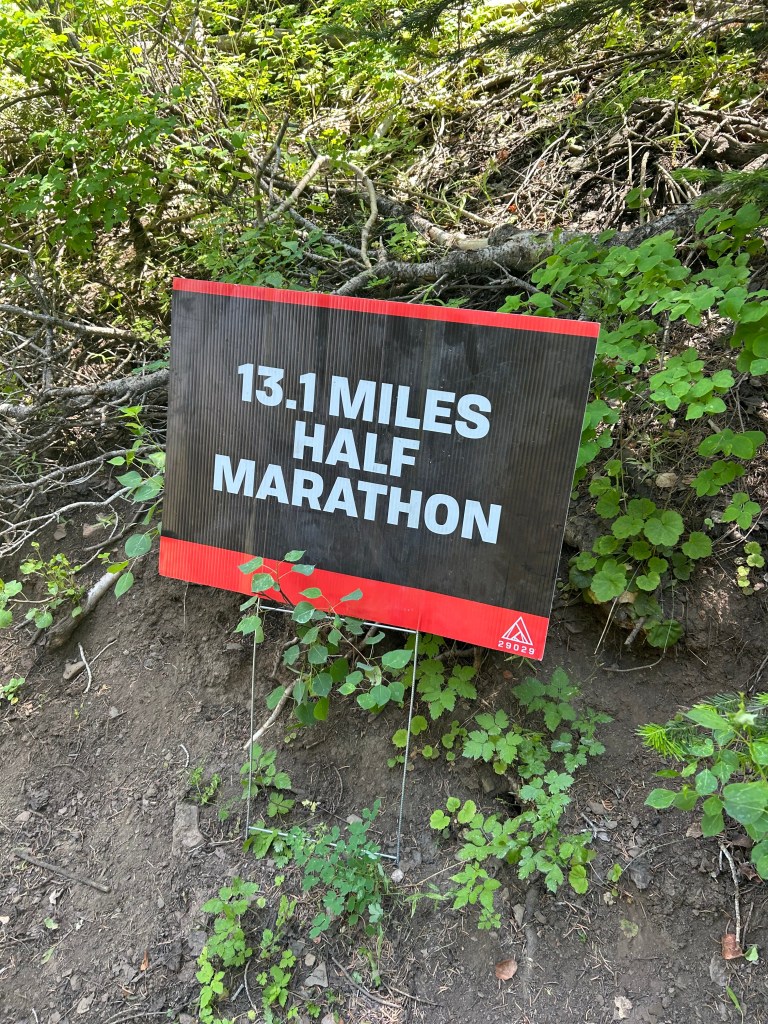
Before I even made it back to my room, after receiving the IV and getting my feet wrapped, I promised Jamie I wouldn’t attempt Day 2. He knew there was a part of me that would be tempted to go out again. But, I promised to stick to volunteering and cheering on the other participants. However, by dinner, moving around had become difficult, and by the next morning, I couldn’t stand up straight. I had re-injured my hip, and the headache and nausea had also returned. I knew it was time to make the hard decision to head home early.

Thankfully, my travel buddy, Karen, chose to head back, too—and I can’t express how grateful I am for her. There’s no way I would have made it through the Dallas–Fort Worth Airport alone. She even paid for someone to push me in a wheelchair through the terminals, because at that point I couldn’t walk on my own. My body was truly revolting, reminding me that even determination has its limits and that rest was no longer optional, but necessary.

And not just for 29029.

I came home with something I didn’t expect, a profound sense of clarity. The climb stripped away all the noise and left me face to face with what really matters—what’s worth carrying and what I need to finally lay down.

It wasn’t just about finishing a physical challenge; it was about recognizing that I’ve allowed certain responsibilities, habits, and even relationships to take more from me than they return. And if I want to keep moving forward—not just up a mountain, but through life—I have to protect what fills me and release what empties me.

Sometimes the bravest thing we can do isn’t pushing harder, but choosing differently.

What I didn’t expect was how deeply this would be reflected in my walk of faith. Ever since this journey began for our family, over 10 years ago, I’ve carried this unrelenting need to stay tethered to the institution of church. (And for clarification, I don’t mean the bride of Christ—I mean the juggernaut of programs, expectations, and structures that so often get mistaken for Him.)

But as time went on, I began to see the business model of church take over—the branding, the performance, the machinery that ran louder than the Spirit. And still, I told myself that staying mattered. Not because I thought I could change it with my own hands, but because I believed prophetic voices were needed. A voice to call us back to simplicity, to presence, to truth.

And, to be clear, those voices are needed.

Just not my voice… in that setting.

The climb made me realize how much that posture has cost me—how much energy I’ve poured into holding space within a system that often confuses profit with purpose. And yet, even in that realization, there’s no bitterness—only a renewed conviction that my faith was never meant to be sustained by an institution, but by Jesus alone.

Since being back, I’ve been a bit reclusive. I’m still working hard behind the scenes, of course, but I’m no longer pouring energy into places—or with people—that leave me feeling empty and, often times, frustrated. Church was never meant to resemble a country club. It was never intended to be a place of status, exclusivity, or performance. It was meant to be a sacred communal space—a gathering of the broken, the seeking, the grateful, the hopeful. A place where walls come down, not where they’re built higher.

At its core, church was designed to be a living, breathing expression of Christ’s body on earth. A table where everyone has a seat, not a stage where a select few put on a show. It was meant to be marked by humility and hospitality, by sacrifice and service, by the kind of love that refuses to keep score.

Somewhere along the way, we traded that vision for something shinier, something more marketable, something that looks successful from the outside but too often leaves souls starving on the inside. And yet, the original design still calls to us—a reminder that sacred community isn’t about belonging to an institution, but about belonging to one another under Christ.

And now I’m trying to figure out what that looks like for me and my family.

Week 47: The Revelations about Community, Purpose, and Church (Part 2 of 3)

My experience in Utah with 29029 was truly life-changing—just ask my family and closest friends. They can tell you how my daily rhythms have shifted and how new boundaries have taken root in my life. But honestly, I think much of what happened there was only possible because of two things that unfolded before I ever boarded the plane.

About ten days before I was set to leave, I had an unfortunate accident on a trail run that left me unable to stand—or sleep. For a couple of nights, I tried to sleep on the couch just to manage the pain. Thankfully, I know some incredible people at Embody in Chattanooga who worked their magic. They got me standing straight again, at least enough to move forward. But from that moment on, my goals for Utah changed. Running was no longer on the table; I decided I would simply try to hike as much of the three half-marathons that I could.

The second thing was harder for me emotionally—my family wasn’t coming with me. Originally, this was meant to be our last family vacation together before Piper left for college in Scotland. I also wanted them to experience the unique community of 29029. Realizing they wouldn’t be there was, for me, the most disappointing part.

The past eight years have been incredibly difficult. We’ve been blessed with amazing people in our lives, but the topic of church—and more specifically, true community—has been painful and complicated. Looking back, I know the unfortunate experiences we endured in Maine left a deep mark, one that has kept most of our family guarded ever since. I wanted them to be there to experience this community.

So… what happened in Utah?

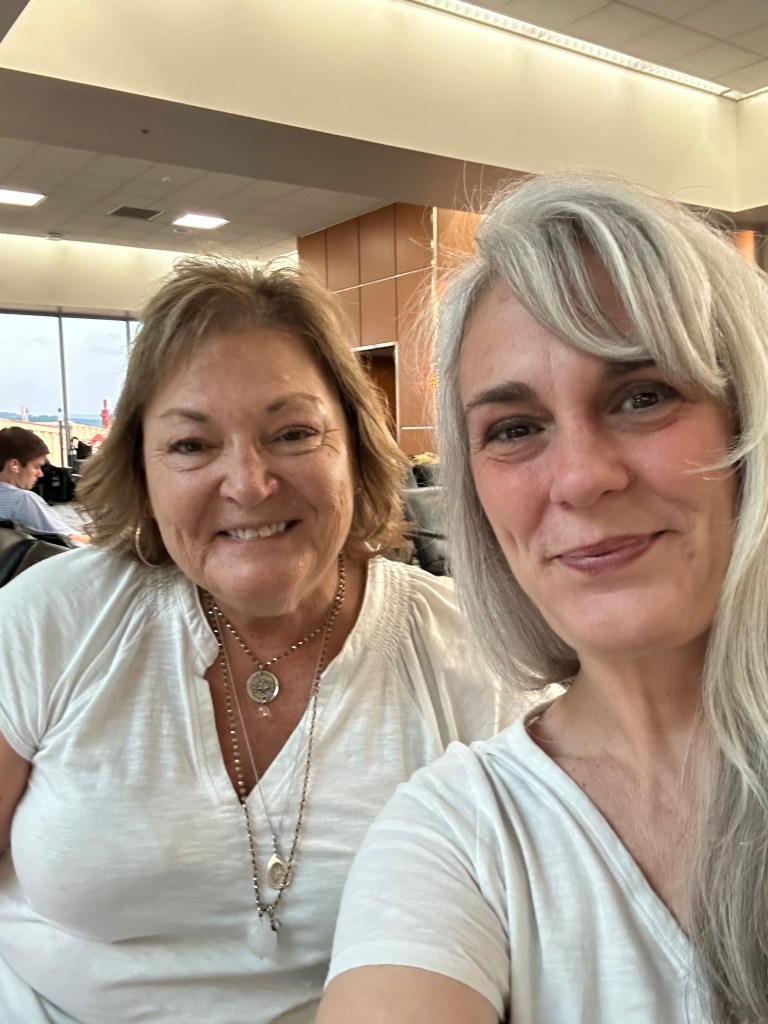
I decided to head to Park City five days early, hoping to give myself a chance to acclimate to the elevation. (Great in theory, but not in actuality.) There was a woman who lived nearby who was also participating—we’d connected a few times online but had never actually met in person. She had already booked her tickets, so I asked if I could tag along. The first time we met face-to-face was at the airport, where we snapped this selfie to send to our coach, Paul.

Karen, my roomie for the next five days, is hilarious. We have very different political leanings, which lent itself to some great conversations… and reminders that it IS possible to find common ground and a path forward. I would also soon find out that Karen is a 29029 celebrity! (You can see her story HERE.)

On our second night in Park City, a group of us went out to dinner. Many of the Park City Trail participants were part of a group thread on Instagram, so we planned a dinner for those who arrived early.

There’s so much I could share about moments like this one, but for the purpose of this project I want to focus on two things: our differences and our connections.

This picture captures six people whose lives look completely different on the surface. During dinner, we went around the table, each sharing a little about our journeys and our why for being at 29029. Four of them were alumni—seasoned climbers who knew what to expect. Carey (on the right) and I were the new faces at the table, wide-eyed and eager to learn. Among us were people with stories of extraordinary, jet-setting adventures and others of us simply trying to keep our heads above water in everyday life.

And yet, around that table, none of that created distance.

At the end of the dinner, Carey took the check to pay for everyone. We all protested, and Carey simply said, “You guys just make a donation to Deirdre’s organization and we’ll call it even.”

That’s when I began to truly understand what people mean when they talk about the magic of the 29029 community. It’s not about status or success—it’s about showing up authentically, encouraging one another, and realizing that even in our differences, we share a common thread: the desire to push ourselves, to grow, and to belong… but also to support one another in the journey of life outside of 29029.

And, even in the middle of something as physically demanding and wildly unique as 29029, I couldn’t escape the whispers of faith. The following morning, as I was quietly working in the lobby, Eric (pictured on the left) walked over and gently asked if he could pray for me. Even now, I get emotional just thinking about it. It wasn’t planned, it wasn’t loud or showy—it was simple, genuine, and full of care.

That moment reminded me that faith has a way of finding us, even when we’re not actively searching for it. Sometimes it looks like a whispered prayer, other times like the presence of someone who sees you and chooses to stop, sit, and lift you up.

Eric was also one of the many 29029 participants who checked in after I returned home unexpectedly early and I’m finding that this kind of care is becoming more and more rare in our society. But, it also revealed something to me: 29029 is about so much more than climbing a mountain. It’s about the people you meet on the path, the connections that form in unexpected ways, and the reminders that even in the most unlikely settings, God has a way of showing up.

The following day, I also had the chance to see another amazing side to this community. 29029 doesn’t just challenge participants to push past their personal limits, it also encourages them to look outward and support causes bigger than themselves. One of those causes is The Kyle Pease Foundation, an Atlanta-based nonprofit dedicated to improving the lives of individuals with disabilities through sports.

Through this partnership, many 29029 participants choose to dedicate their climbs and their training journey to raising funds for the foundation. It’s inspiring to see athletes who are already working so hard physically also channel that determination into opening doors for others—helping provide adaptive equipment, race entries, and opportunities for inclusion that otherwise might not be possible.

(The owner of The Happi Brand made these shirts as a fundraiser for The Kyle Pease Foundation and you know I’m working on a way for BTCYI to work with her!)

It’s one thing to witness people summiting mountains for their own growth, but it’s another to see them do it while carrying others with them, ensuring that every step on the mountain creates a ripple of impact far beyond the event itself. This spirit of generosity is what makes the 29029 community so unique: it’s not just about climbing your own mountain, but making sure someone else gets to climb theirs too.

Two days in, I was hoping the altitude would start to feel a little easier, but instead the headache lingered and the nausea only grew worse. I finally made the tough decision to skip a group hike the day before the race. That’s when another participant, John, offered to walk with me to grab a coffee—his way of helping me fight through the relentless headache. It may have seemed like a small gesture, but to me it was another powerful reminder of the kind of community 29029 creates: one where people truly notice, show up, and care for one another in the simplest yet most meaningful ways.

And when it came to race day, I had two goals: go as far as I could go and to make the most of the time I had alone on the mountain. This event begins at approximately 7,000 feet above sea level and tops out at about 10,000 feet. And on Day One, arguably the toughest day, the first 10 miles are pretty much all up hill. So, like everything else in life… it was just about putting one foot in front of the other. And that’s what I did for the first four miles…

Until I started throwing up.

And it wasn’t pretty.

Once I started, I couldn’t stop. I texted my coach (Paul) for advice hoping he’d have some miracle cure, or trick, I could try. And I’m going to be honest: I was scared. I knew it wasn’t something I ate because I was eating the EXACT same things that I trained with. And NOTHING I did made it any better… and I tried everything. Paul was stationed at the end of the race, so he couldn’t come out to help me, but he sent reinforcements, another coach, Jen.

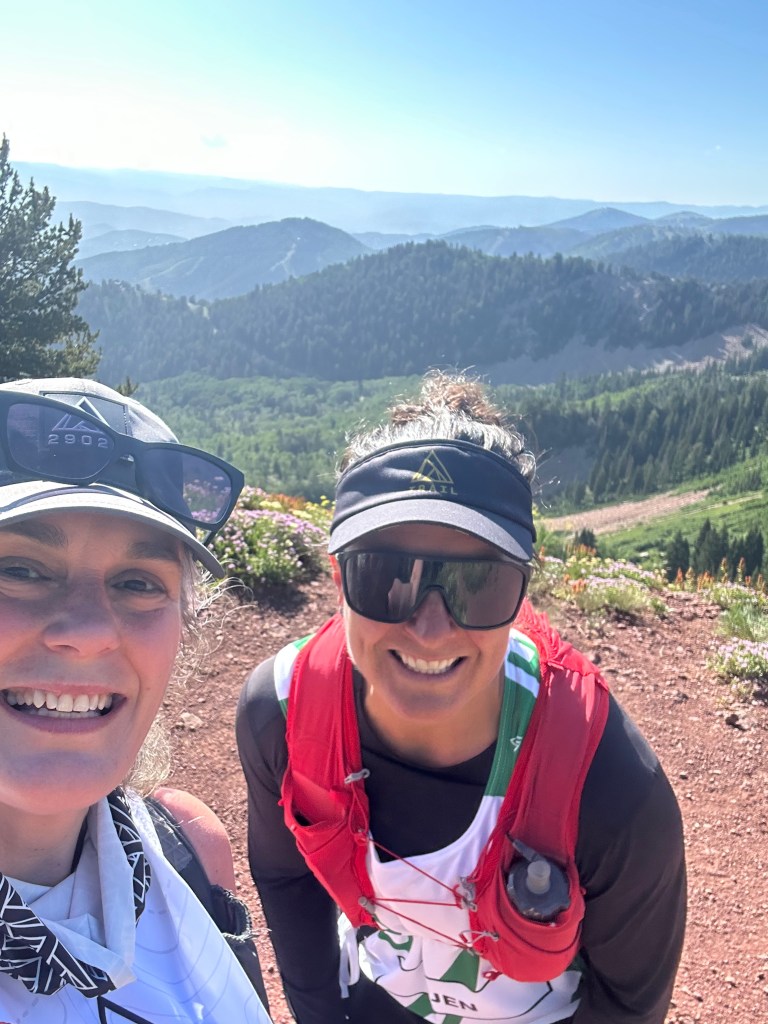
And my time with Jen was the highlight of my trip.

Coach Jen, a cornerstone of the 29029 community, has spent over 20 years at the top of ultra running and adventure racing, cementing her reputation as one of the world’s leading endurance coaches. Known for her expertise and empathetic approach, she has guided athletes to some of the toughest challenges on earth, including Western States 100, Badwater 135, Tahoe 200, and even multi-day expedition, and even climbing Everest. Celebrated globally for transforming both novice and elite athletes, Jen continues to compete, coach, and inspire—making her one of the most trusted and respected voices in endurance sports.

She walked beside me for two miles on the mountain—through waves of nausea and bouts of vomiting—steady, patient, reminding me that all I needed to do was take one step at a time. In those two miles, something deeper unfolded. Coach Jen shared pieces of her story, and I opened up about mine. Before long, our conversation turned to our kids, to the complicated world they are growing up in, to the relentless pressures pressing down on them, and to the ways we as parents often feel unprepared to guide them through it all. That exchange reminded me that 29029 isn’t just about the physical climb—it’s about what the mountain represents. The grit, the setbacks, the mental battles, and the emotional weight we carry. The ethos of 29029 is not only conquering vertical feet, but facing life’s challenges head-on, step by step, and realizing we’re not alone in the climb.

It sounds cheesy.

I know.

But, it’s true.

After those two miles, I faced a choice: step aside or keep going. Coach Jen asked how I was feeling—both physically and mentally. By mile six, the vomiting had stopped, and by mile seven, the nausea had nearly faded. I decided to push on, aiming for the half marathon, but also knowing there was a very good chance I wouldn’t make it. But it truly didn’t matter. The finisher’s scarf, the medals, the pieces of leather you get to brand with the TRAIL logo…. everything that acknowledges the accomplishment.

They no longer mattered.

If Coach Jen hadn’t been there beside me, I’m almost certain I would have quit. I felt completely defeated—every step felt heavier than the last, and the mountain seemed insurmountable. Her presence, her steady encouragement, and the simple act of walking with me made all the difference. She reminded me that I didn’t have to face the struggle alone, and that sometimes the support of another person is enough to turn defeat into determination.

With just eight minutes to spare, I reached the first-aid station—exhausted but still moving. Coach Chris, the head coach, looked me in the eye and told me I’d have to hustle if I wanted any shot at reaching the half-marathon mark before the sweep. The medics quickly retaped my feet, Coach Emilee handed me a peanut butter and jelly sandwich, and then I was back on the trail.

And then, as if the mountain had a sense of humor, it was literally all uphill from there—at 10,000 feet no less. Every 20 feet I had to stop, trying to catch my breath, fighting the altitude and the fatigue. (Vomiting drained me of nutrition and energy.) But step by step, break by break, I pushed forward. And somehow, I made it to the half-marathon point before the sweep cut me off.

The downside: I had two more miles to the next aid station and I had nothing left in the tank… and the vomiting was back. Somewhere past Mile 14, Coach Chris caught up to me, and God bless him, he stayed with me for a mile and a half. I won’t rehash all the details of that stretch—let’s just say it was humbling—but I will say this: the 29029 coaching staff is extraordinary. They aren’t just there to get you up the mountain; they’re there to walk with you through the darkest, hardest parts, when your body is shutting down and your mind is begging you to quit. They embody the ethos of 29029: that the climb is about so much more than vertical feet—it’s about resilience, about finding strength you didn’t know you had, and about realizing that sometimes the only way forward is because someone else believes in you enough to stay by your side.

I got back to the hotel and immediately went to get an IV and have my feet taped up, because here’s the crazy part: despite everything my body had just gone through, I was planning to head back up the mountain the very next day. It sounds wild, but in that moment, my mindset wasn’t about quitting—it was about getting back to the mountain, because up there I was learning things about myself I couldn’t find anywhere else. Every step, every wave of exhaustion, every doubt that crept in—it was all stripping away the noise and showing me what I was really made of and what was ACTUALLY important in my life…

…which has led to some significant changes since I’ve been back home.

The mountain was less about conquering an elevation and more about uncovering a deeper resilience, and I wasn’t ready to walk away from that lesson just yet.

But my body demanded a different kind of strength—knowing when to stop.

Also, something I’ve taken to heart since being home.

Week 46: Finding Community Outside of Church (Part 1 of 3)

When I first started this project, my goal was to visit a different church in the Greater Chattanooga Area every Sunday and share those experiences here. And for the most part, I’ve stayed true to that. But in July, I hit the road and had planned to take a short break from writing. What I didn’t expect was how much those 10 days away would shift my perspective on community—largely thanks to an unexpected and intriguing group of people I encountered in Utah at 29029.

But, I guess the first step is giving you some context.

A little over a year ago, I was sitting with Holden on the couch as he was showing me some YouTube videos. That’s when I stumbled across my first 29029 video.

For those who don’t know, before Be The Change Youth Initiative uprooted our family from Maine and launched us into a year-long journey around the country, I was heavily involved in endurance events—triathlons, half-marathons, and even one full marathon. I didn’t just do them for the physical challenge; they were a way to raise money and awareness for causes I cared deeply about. But over the past eight years, my life has been fully wrapped up in Be The Change—heart, soul, and time. The races stopped, the training stopped, and honestly, I didn’t realize how much I missed them… until recently.

So, after I stumbled across 29029 I started watching their videos—a lot of their videos. Over the course of that following month, I found myself going down the rabbit hole. I laughed, I cried (a lot), and I couldn’t stop asking myself the same question over and over: Is this community they keep talking about real? Or is it just smart branding and emotional hype?

It’s real. (But it’s also smart branding.)

And before I go any further, I want to take a moment to address two things: the cost and the training.

The Cost:

The cost of participating in a 29029 event—is a lot. Honestly, it was way more than our family could afford, especially running a nonprofit and living on a pretty lean budget. When I first saw the price tag, I immediately thought, There’s no way. It felt out of reach. It also felt irresponsible given our family’s financial situation. But the more I learned about the event—and the more I felt that persistent nudge—I started asking a different question: What would it look like to invest in something that wasn’t just about finishing a physical challenge, but about stepping into a space of deep personal growth… where I could rediscover parts of myself I’d put on hold?

We talk so often in our work about creating spaces where people feel seen and supported. What if this was one of those spaces for me?

So, after talking it over with my family—and making sure they fully understood the time commitment and what I was signing up for—I officially registered for my first 29029 event.

But here’s the catch: it wasn’t the one I wanted.

One of the wild things about 29029 is just how fast these events sell out. I mean, who knew that hiking up a mountain and riding a gondola back down over and over again until you’ve climbed the equivalent of Mt. Everest would be such a hot ticket?

My first pick was Mont-Tremblant but that event sold out before it even opened to the general public. (Pro tip: alumni get early access, and they do not mess around.) I moved on to my second choice— Whistler —but that one vanished in a matter of seconds, too. At that point, the only remaining event that fit into my calendar was Park City and to be completely honest, I had zero interest in TRAIL.

That event starts at 6,000 feet above sea level.

I live pretty much at sea level.

I didn’t want to do one marathon at altitude, let alone three way above sea level. But it was my only shot… so I signed up anyway.

The Training:

The training itself was incredibly demanding. Between my work responsibilities and frequent travel, I quickly realized that sticking to the group’s prescribed schedule was simply unsustainable for me. To make it work, I decided to bring on a coach who could tailor a plan around my existing commitments.

And this is really where the gap between my expectations and reality began to show. One of my biggest motivations for joining this group was the sense of community—I was looking forward to connecting with others through a shared experience. But I soon found that not following the same training plan made it much harder to engage meaningfully. There’s a natural camaraderie that forms when people are going through the same process, at the same pace, and I found myself feeling a bit out of sync with the group because of my modified approach.

Honestly, I began to feel like I wasn’t doing enough, compared to everyone else… and I was in my head about it. Even though I was putting in a lot of effort and working with a coach to stay consistent, it still felt like I was falling short. I’d scroll through group messages or see updates from others sticking to the original plan, and I couldn’t help but compare. It was as if, because I had to adapt the training to fit my life, my commitment didn’t seem as valid—or at least, it didn’t feel that way to me. That creeping sense of inadequacy started to chip away at the initial excitement I had when I joined.

That was 100% on me. (You see, I was already learning a lot about myself before I even stepped foot in Utah!)

But I ended up reaching out to another participant who lived close to me. We weren’t on the same training plan, but we found common ground in proximity—and eventually, in intentionality. We started texting each other, checking in from time to time, sharing updates, encouragement, and small wins. I wanted to stay engaged and connected, even if it looked different than I originally imagined. So I made a concerted effort to create community in a way that fit the reality I was living in.

I share this because I think it’s important to the bigger conversation around community—especially within the Church. So often, we talk about community as something that just happens if you’re “in the right place” or following the same path, or routine, even proximity. But true community takes intentionality, vulnerability, and creativity. It’s not always built in structured gatherings or perfect alignment—it’s built in the check-ins, the shared spaces, the quiet efforts to show up for one another.

Something I saw plenty of in Utah and will share more about next week.

And sometimes, we have to give ourselves, and others permission, to build community outside the “official” structure. That doesn’t make it less meaningful—it might actually make it more Christlike. Because the heart of church community isn’t about uniformity, it’s about unity through grace, presence, and mutual care.

And 29029 does this so incredibly well.

(Part 2 will be all about my time in Utah and the incredible people I had the privilege to meet.)

Week 45: Reimagining the Church Gathering

Church was never meant to be a place we go, but a way we live. For too long, we’ve equated faithfulness with attendance—filling pews, nodding through sermons, and calling it “community” while remaining largely unknown to the people sitting beside us. The early church wasn’t centered around a stage or a pulpit, but around shared meals, mutual care, and Spirit-led conversations. It was radically relational, inconveniently intimate, and beautifully messy.

Imagine if the gathering of believers looked less like a weekly performance and more like a family dinner. No more passive consumption of prepackaged inspiration. No more being “fed” while never being asked to contribute. Instead, we gather around tables, not stages—where everyone brings something to share, not just food, but story, wisdom, prayer, vulnerability. Church as a way of life, not a calendar event.

What might happen if we stopped going to church… and started being the church?

A few weeks ago, my friend Neil invited me to join a small gathering at Crabtree Farms—a place already rooted in the values of growth, collaboration, and community. Around the table were six of us from different walks of life: three of us work for youth-focused nonprofits, one works directly with the City of Chattanooga, and two others run their own photography and videography businesses. At first glance, our roles seemed diverse, but it quickly became clear that we shared something deeper: a genuine commitment to supporting and uplifting young people in our community. Whether through policy, storytelling, creative expression, or hands-on outreach, we each understand that investing in youth is one of the most powerful ways to shape a more just and hopeful future.

Words like ministryfaith, and outreach weren’t just sprinkled throughout our conversation—they were threads, quietly and consistently weaving everything together. As we shared our stories, there was a sense that this wasn’t just a meeting or a moment. It was something deeper.

Another word kept rising to the surface—sacred. Not in a formal or distant way, but in the quiet recognition that something holy was happening in the space between us. The vulnerability, the honesty, the shared longing to serve and be part of something bigger—it all felt set apart.

But here’s the thing about what is sacred: it doesn’t stay that way by accident. Sacredness is sustained through continued presence, continued listening, continued showing up for one another with open hands and honest hearts. It’s not a spark we admire and walk away from. It’s a fire that needs tending.

To call something sacred is to take responsibility for it.

To name a moment, a mission, a relationship as holy is to commit to its care. Not with grand gestures or perfect plans, but with steady faithfulness. With the courage to keep coming back to the table, to keep having the hard conversations, to keep letting love lead—even when it’s messy or slow.

What we experienced, I hope, wasn’t just a fleeting moment of connection. It was a beginning. And it will only remain sacred if we continue—continue the work, continue the community, continue the invitation to let God move in and through us.

Sacredness isn’t static. It’s alive. And it’s ours to steward.

I’ve been reflecting on this a lot lately—especially when I think about the intersection of my personal life and the work I feel called to do. There’s a tension our family carries, one that threads through so many areas of our lives. It’s hard to name sometimes, let alone explain. It’s the kind of tension that isn’t easily resolved, because it’s born from choosing to live intentionally in spaces that don’t always make sense to the world around us.

Someone recently described our family as “an anomaly of the human experience.” And while I don’t fully agree with that, I get where they’re coming from. From the outside, our choices may look unusual or even contradictory—but from the inside, it’s simply the result of holding multiple truths at once: conviction and compassion, struggle and hope, sacrifice and joy. It’s complex, and it’s messy, but it’s also deeply human.

Also, my husband and I, on more than one occasion, have said, “What the f&#k are we doing?” Jamie actually said it this morning.

Honestly, with the exception of our youngest, I’m pretty sure at least one of us says it every single week. Sometimes daily. But that’s what happens when you raise your kids to think critically, care deeply, and speak boldly.

You want them to question injustice… until they question your choices.
You want them to stand up for what they believe in… until they call you out for being inconsistent.
You want them to be independent thinkers… until they’re strong-willed and inconveniently vocal.

But here’s the thing: we wouldn’t trade it. Not even on the days it feels like we’re unraveling… which was pretty much EVERY. FREAKING. DAY. in July.
We didn’t set out to raise agreeable kids — we set out to raise compassionate, curious, courageous humans.
And yeah, that means living in a house where hard questions get asked, opinions get challenged, and none of us are allowed to just coast through life on autopilot.

It’s chaotic. It’s messy. It’s exhausting.
But if we’re being honest — it’s also kind of beautiful.

We’ve also noticed a striking — and sometimes frustrating — similarity between many of the conversations happening in the nonprofit world and those we encounter in church spaces.

In both spheres, there tends to be an entrenched mindset around “the way things are done.” These norms are often treated as unshakable truths, even when they no longer serve the people they’re meant to help. But if we’re truly committed to seeing different outcomes — more equity, deeper relationships, lasting transformation — then we have to be willing to reimagine the systems themselves. We believe there are other ways of doing things. More collaborative, creative, and community-driven approaches that challenge the status quo and lead to the kind of change we say we want.

And I’m not gonna lie.

There are days when I find myself longing for the version of church life we left behind years ago. I miss watching my kids leading worship — the familiarity of Sunday mornings, followed by lunch in the fellowship hall. I miss the structure: the midweek Bible studies that gave us a sense of spiritual anchoring, the weekend retreats that created space to breathe and reconnect, the occasional outreach project that reminded us of something bigger than ourselves.

But even in the midst of all that familiarity, there was always a quiet discomfort I couldn’t shake — a sense that something just didn’t sit right. So much of what we were part of revolved around an insular way of living. The rhythms and routines, while comforting, often felt closed off from the world around us.

Most of our time was spent inside the walls of a building, surrounded by people who looked, thought, and believed the same way we did. Activities were neatly compartmentalized — youth group on Wednesday, service on Sunday, maybe a mission trip or canned food drive once a year. Everything was curated to fit a spiritual checklist: attend, participate, serve, repeat. It was well-intentioned, but it often felt like we were going through the motions rather than engaging the deeper questions of faith, justice, or real-world impact.

It became hard to ignore how disconnected that model was from the messy, beautiful complexity of everyday life — and from the very people we were called to love.

Maybe that’s why we often find ourselves feeling frustrated — both with the nonprofit world and the church world. In many ways, they mirror each other: systems built with good intentions that, over time, can become more focused on preserving structure than serving people.

But for us, our motivation has never been about maintaining the way things have always been done. Whether we’re navigating faith spaces or community work, our heart has always been rooted in the same question: Is there a better way forward? One that truly centers the people we’re trying to serve — not just our comfort, our traditions, or our metrics of success.

We don’t believe there’s only one path to meaningful change. In fact, we believe real progress requires us to stay open — to question, to listen, and to imagine alternatives. There can be more than one way to move forward, and sometimes the most faithful, most impactful thing we can do is to leave the well-worn path and help create a new one — even if it’s slower, messier, and more uncertain.

Because if the outcome is greater dignity, deeper connection, and communities that truly flourish — then the risk is worth it.


Week 44: It’s not about whether the table is big enough… but whether or not you want to pull up a chair.

Well, this past week has been… exactly what I expected.

Some people really didn’t like what I’ve had to say. Others have reached out with deep gratitude, saying they finally feel seen, heard, and understood. And honestly? I’m holding both responses with open hands.

I’m not intimidated by criticism—honestly, as an Enneagram 8, I welcome thoughtful, objective feedback. And I don’t find validation in praise either (if I’m being honest, I tend to question people’s motives). I don’t write to win approval. I write because I believe these conversations matter—and because staying silent never sat well with me.

So often, conversations about inclusion start with logistics. Is there room? Can we make space? Do we have the capacity? But when it comes to LGBTQ+ inclusivity—especially in faith communities—these questions often mask a deeper one: 

Do we actually want everyone here?

Let’s be honest… we can invite people to the table, but if we never offer them space to speak, to lead, to shape the conversation, then it’s not really inclusion. If we control the menu, the agenda, and the tone of the gathering, we’re not building community. Real belonging demands more than a seat; it requires shared power, mutual respect, and the humility to be changed by voices different from our own.

So the question isn’t “Who’s invited?”—it’s “Who feels truly welcome, truly heard, and genuinely valued when they get there?” Because until the table becomes a place of shared ownership, not just extended hospitality, we’re not practicing justice—we’re just rearranging the furniture.

With this being the last post in this series, I want to explore what it means to create not just a bigger table, but a more courageous one—one where love isn’t conditional, and belonging isn’t up for debate.

I’ve heard people say you can’t drink coffee and be a Christian.
I’ve also heard people say the same about alcohol.
You can’t be gay and be a Christian.
You can’t get a tattoo.
You can’t vote for a Democrat.
You can’t vote for a Republican.
You can’t be divorced.
You can’t cuss.
You can’t doubt.
You can’t question the pastor.
You can’t miss church on Sunday.
You can’t wear certain clothes.
You can’t listen to secular music.
You can’t practice yoga.
You can’t be rich.
You can’t be poor.
You can’t go to therapy.
You can’t have anxiety.
You can’t love Jesus and still struggle.
You can’t be a woman and preach.
You can’t read a different translation of the Bible.
You can’t love people too radically, or else you’re “watering down the gospel.”

Honestly, the list is long—and often contradictory.

But here’s what that long list tells me:
We don’t all read Scripture the same way.
We bring our stories, our cultures, our traditions, and our wounds to the Bible.
And how we interpret it often says more about us as it does about God.

So when someone says, “You can’t be gay and be a Christian,”
I no longer hear a definitive theological truth.
I hear an interpretation—one shaped by how they’ve been taught to read Scripture.

That’s why we need to keep asking better questions.
Not just “What does the Bible say?” but “How are we reading it?”
And maybe even more importantly: “What kind of God are we revealing in the way we read?”

Because the truth is, how we read the Bible has never been static.
Take the word “homosexuality,” for example. Many people assume it’s always been in Scripture—that it’s a fixed, unquestionable part of God’s Word. But that’s simply not true.

As I mentioned in a previous post, the word “homosexual” didn’t appear in any English translation of the Bible until 1946—in the Revised Standard Version. That’s nearly 2,000 years after the New Testament was written, and centuries after the Bible was first translated into English. In the original Greek, the words used—like arsenokoitai and malakoi—are complex, debated, and deeply context-specific. Scholars still argue about their exact meaning. But what we do know is this: the modern concept of sexual orientation didn’t even exist in biblical times.

So when we say “the Bible clearly says…”—especially when it comes to LGBTQ+ people—we have to pause and ask:
Are we interpreting Scripture faithfully?
Or are we projecting modern assumptions onto ancient texts?
Are we seeking truth?
Or are we defending what makes us most comfortable?

And even more than that:
Are we using Scripture as a weapon—or as a window into the heart of a God who consistently lifts the marginalized, welcomes the outsider, and redefines who belongs?

Because how we read the Bible will always reveal the kind of God we believe in.
Is that God harsh, distant, and conditional? Or is that God radically loving, just, and present—especially with those who’ve been pushed to the margins?

The difference matters.
Not just for theology—but for real people with real lives, real pain, and real hope.

The truth is, Christians have always read Scripture differently. Across denominations, cultures, and generations, we’ve come to different conclusions about what’s literal, what’s cultural, what’s timeless, and what needs context.

For some, drinking alcohol is a sin. For others, Jesus turning water into wine is all the clarity they need. And yes, there are even communities who believe coffee is off limits because of its stimulating effect. The point isn’t who’s “right”—the point is this: our understanding of Scripture is always shaped by how we read it, where we read it from, and who taught us how to read it.

So when we talk about topics like LGBTQ+ identity and inclusion, the question isn’t just what does the Bible say?—but how are we reading it? Are we taking time to understand the cultural context, the original language, and the overarching story of God’s love and justice? Are we reading to exclude or to invite? To shame or to understand?

If we’ve been taught that God’s love has limits, we may struggle to believe that full inclusion is possible. But if we’ve experienced the Spirit of God moving in and through the lives of LGBTQ+ people—and if we approach Scripture with humility, curiosity, and care—we might begin to see something new. Or perhaps, something ancient and true, but often missed:

Belonging doesn’t require erasure.
God’s image shows up in all kinds of bodies and stories.
Reading the Bible faithfully means holding space for both truth and transformation.

I’ll end with this…

For years, one of my greatest fears wasn’t just being wrong—it was what might unravel if I admitted I was wrong. Especially about something as deeply rooted as my “biblical stance” on LGBTQ+ inclusion.

Because if I was wrong about that… what else might I be wrong about?

It felt like tugging on a single thread that could undo the whole fabric of my faith.
And for someone who built their life on certainty, clarity, and theological boundaries—deconstruction wasn’t just scary. It was off-limits.

It wasn’t that I lacked compassion.
I just thought love meant telling the truth—even when it hurt.
But what I didn’t realize was that truth without humility can harden into something unrecognizable from the Jesus I claimed to follow. And fear of being wrong kept me from seeing the harm that my “clarity” was causing.

I thought my faith would fall apart if I opened that door.
But what I’ve found—on the other side of honest questions and sacred wrestling—isn’t less faith.

It’s a deeper faith.

Less about rigid certainty, and more about radical trust in a God who’s big enough to hold our doubts, and kind enough to transform our understanding without shaming our past.

So no—deconstruction wasn’t an option for me…
Until it became the only faithful path forward.

A path toward a more honest faith.
A faith not built on fear of getting it wrong, but on the courage to ask deeper questions.
A faith that makes room for complexity, nuance, and growth.
A path toward Jesus—not the version I was handed, but the one I kept catching glimpses of in the margins, in the tension, in the faces of people I was once taught to exclude.

It wasn’t a path I chose lightly.
It was slow. Painful. Lonely at times.
But it was also liberating. Healing. Sacred.

Because sometimes, the most faithful thing you can do… is let go of what no longer reflects the heart of God—and trust that what remains will be true and more like Christ.