WEEK 12: Find Yourself Some Friends Like These

Who: Katie, Chase, and Sydney

Church: Thankful Memorial Parish (Episcopal)

Lunch: The Hot Chocolatier

Topics: The Institution of Church vs The Real Church, The Kingdom of God

We first met Katie and Chase in September 2021 at a panel discussion entitled Youth Mental Health & the Church. They were invited to attend the discussion, where Sydney and I spent some time talking about our story and our work in the community. It was a unique moment where our faith and our mission intersected in a formal setting since moving to Chattanooga. This panel was the culmination of six months of collaboration, with mental health and church leaders meeting monthly to address blind spots, missed opportunities, and areas for growth in how the church can better support young people and their families.

Since then, Katie and Chase have become close friends for so many reasons. They’re as genuine as it gets, never taking themselves too seriously, and every time we’re together, there’s no shortage of laughter. Yet, they’re also deeply thoughtful about life and faith. I know I can text them about any theological question I’m wrestling with, and they’ll respond with honesty and insight, always taking the conversation seriously. They’re also avid live music fans and have shown up for our kids on so many occasions to celebrate them.

Find friends like this. You need them.

Now for the our experience on Sunday: Nestled in the heart of the St. Elmo community, the church has a quiet, tucked-away charm that instantly reminded me of the beautiful stone churches we visited in Scotland last summer. Its architecture and serene surroundings exude a timeless beauty, and stepping inside brought an immediate sense of peace and reverence. The space felt like a sanctuary from the everyday, where history and tranquility blend to create an inviting atmosphere for reflection and connection.

Over the years, I’ve attended only a handful of Episcopal churches, but one aspect that stands out as a constant is the deep attention given to liturgy. Episcopal services have a unique reverence and structure, a thoughtful rhythm that carefully guides each part of the worship experience. This attention to detail creates a sacred atmosphere that invites everyone to participate fully, engaging the heart, mind, and spirit. The use of ancient prayers, communal responses, and symbolic actions connects worshippers to centuries of Christian tradition, offering a sense of continuity that transcends time and place. It’s a beautiful reminder of the church’s commitment to intentionality and depth in worship, where every word and gesture feels meaningful and purposefully directed toward honoring God.

Sydney and I felt a little scattered. A traditional Episcopal service has its own cadence, a kind of rhythm we’re not used to, with each part of the service flowing into the next. But we found ourselves fumbling through it, juggling books and bulletins as we tried to follow along with everyone else. When it came time to kneel for the prayers, we had a funny moment, laughing at ourselves as we balanced everything in our hands, wondering how to make it work.

Despite the initial awkwardness, though, there was something really special about being there. There’s a deep sense of community and belonging in that small church, a feeling that everyone is genuinely welcome. It’s something you can feel from the way the members interact with each other and with newcomers like us. We may have felt a bit out of sync, but being in that space still left an impression on us—a reminder of how meaningful a tight-knit community can be, even when the rituals feel unfamiliar.

After church, the four of us grabbed lunch at The Hot Chocolatier and we talked about… all the things: how they decided to make this church their home, the election, the comparison between the institution of church and what we commonly refer to as the REAL church, and the Kingdom of God. I could spend an entire blog post writing about each of these… rich, complex, and full of nuance… but I want to focus on the latter two for this entry.

The topic of differentiating between the institution of church and the REAL church has actually come up several times over the past week. So, for the purposes of clarity, I want to explain what I’m referring to with each of these concepts:

Institution of Church: Universally, the term often refers to the organized, formal structures of the church, which include the buildings, denominations, leadership hierarchy, programs, and official doctrines. These structures are often governed by policies, traditions, and human-made systems. For the record, I don’t believe these elements are inherently bad; they can serve essential purposes. However, I do think we’ve often placed too much emphasis on what happens within church walls on Sunday mornings, sometimes to the detriment of living out our faith the rest of the week. At its best, the institution can provide a foundation for community, support, and shared worship. But at its worst, it has been misused by those with selfish agendas, distorting the Christian faith for personal gain, power, or control. When this happens, it risks becoming an obstacle to genuine spiritual growth, overshadowing the real mission of the church: to be a compassionate, active presence in the world, fostering love, justice, and transformation beyond any single gathering. And somewhere between those extremes lies a very real issue: we often allocate more resources to maintaining buildings than to caring for the marginalized in our communities. When I refer to the institutional church, I’m specifically referring to the extremes of that spectrum, those who have distorted, or completely missed, the mission Christ left to his people.

Real Church: The real church, in a theological sense, is often seen as the body of believers united in their faith in Christ. It’s described as a spiritual community transcending any physical or organizational boundaries. The real church includes people from diverse backgrounds, denominations, and cultures, connected by shared beliefs, values, and love for one another. It emphasizes relationships, mutual support, authentic worship, and the lived expression of faith. The real church is about living out values, serving others, and reflecting the teachings of Jesus in everyday life.

But, I want to close out this post with our conversation about the Kingdom of God. I’m currently doing a study by Jamie Winship that has had me looking at the Kingdom of God, juxtaposed with Christianity. And as we talked about this over lunch I really appreciated the perspectives that Katie and Chase offered. At the end of the day, the Kingdom of God is a central theme in Jesus’ teachings, referring to God’s rule, presence, and influence over all creation. It is not a physical territory but rather a spiritual reality where God’s will, values, and justice reign. It is marked by peace, compassion, humility, and a focus on uplifting the poor, marginalized, and oppressed.

Christianity, on the other hand, is the organized religion and faith tradition that has developed around the teachings, life, death, and resurrection of Jesus Christ. It includes specific beliefs, doctrines, practices, and denominations, as well as historical and cultural structures. While Christianity’s purpose is to help those wanting to follow Christ and, ideally, to reflect Kingdom values, it is also shaped by human institutions, customs, and interpretations. And even though Christianity has been the primary means through which the message of the Kingdom is shared, it is not synonymous with the Kingdom itself. (Yeah… that might be a hot take, but that’s where I stand on it.)

One of the things that has stuck with me this week has been Katie’s comment that the Kingdom of God isn’t just about the people of God. It’s about the presence of God. It’s about the work of the Holy Spirit. It’s about so much more than us.

CHALLENGE: When you think about the Kingdom of God, what specifically do you think about? How does the religion of Christianity fit into your understanding of the Kingdom of God?
WEEK 11: Headed to the North Shore

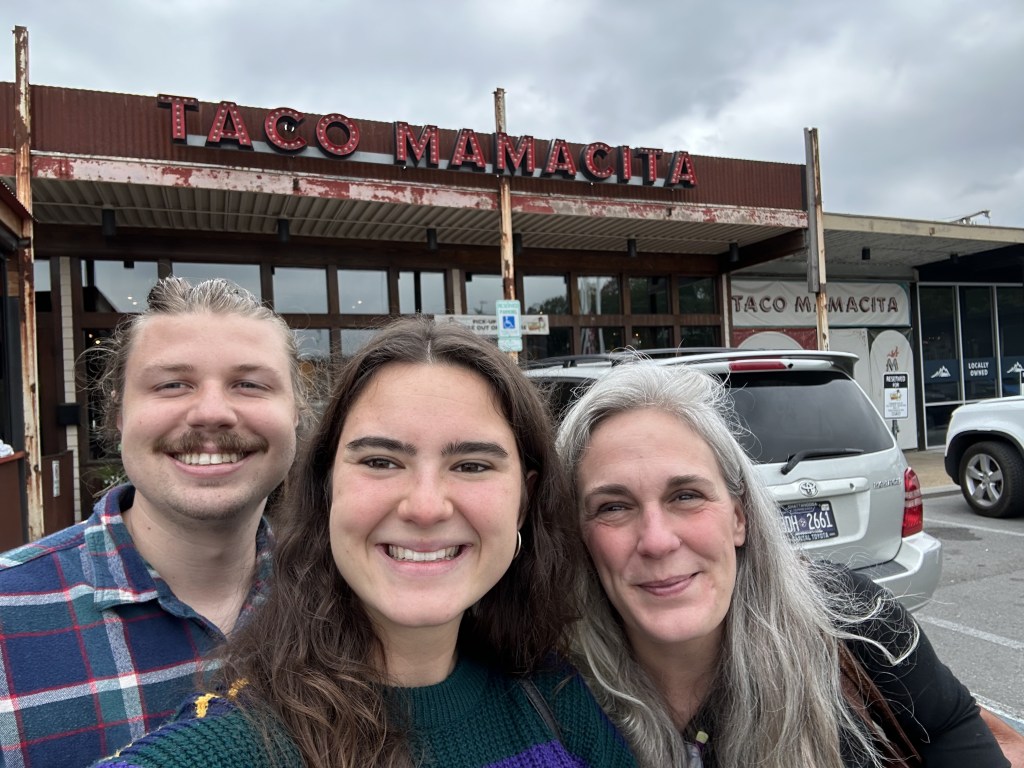
Who: Katie and Clay

Church: North Shore Fellowship (Presbyterian)

Lunch: Taco Mamacita

Topics: Living by Faith and Not Having All the Answers

This week, I crossed the river to join Clay and Katie at North Shore Fellowship. I met these two wonderful people through my kids, but they’re also happen to be monthly donors to BTCYI. (And if Katie looks familiar, you might recognize her from Be Caffeinated, where she works as a barista!) I appreciated our time at North Shore Fellowship, but it was our conversation after the service that truly left me feeling encouraged and inspired.

Both Katie and Clay were raised in the church and have an acute awareness of cultural Christianity, especially in the South, as well as the political phenomenon known as Christian nationalism—how religious identity is sometimes blended with patriotism in ways that influence politics, community dynamics, and even individual beliefs. And during our conversation over lunch, both Katie and Clay shared a thoughtful approach to faith that challenges assumptions and emphasizes authenticity over cultural expectations.

Yet another reminder as to why I have confidence in the future. (Besides Jesus, of course.)

With regard to the Sunday morning service, North Shore Fellowship reminded me a lot of my Grandma’s church growing up. Both the building and the people. And the bulletins. (I still remember countless Sunday mornings filling the margins of those bulletins with doodles and drawings.) The building itself is old, but that also holds some of it’s charm. The demographic is primarily caucasian. But there was a lot of generational diversity. And, weirdly enough, I didn’t recognize one single worship song. It was VERY old school, but it was also very beautiful.

And, I’ll be honest, I can’t remember what the sermon was about, except it was based on a section from the book of Daniel. Confession: I’ve been distracted the past couple of weeks. And while it might be easy to say the election was the reason, it wasn’t. At least not when it comes to the actual source of the distraction. There’s a clear divide in our country and animosity runs deep… on both sides. But, there’s also a clear divide in the “American Church” that is deeply disconcerting.

And this has been the distraction for me, and my family, for quite some time. And I’d be lying if I didn’t acknowledge that the repercussions of this election, NO MATTER THE OUTCOME, have taken up a lot of space in my mind. But, I also think this conversation with Katie and Clay helped me sort through some of those thoughts and feeling because their perspectives brought a sense of clarity and grounding. 

Having both been raised in the church, their familiarity with cultural Christianity gave them a deep understanding of the nuanced blend of faith and tradition, and how easily inherited values can go unquestioned. This has helped them navigate their own beliefs with a balance of respect for their roots and a desire for authentic faith. This background made our conversation more insightful; they could empathize with the struggle between living out a genuine relationship with faith versus just going through the motions.

One of the things I’ve come to understand about religion, particularly within the Christian tradition, is that many people approach their beliefs as absolute truth. At its core, it comes down to this: our beliefs are what we accept as true, often without concrete evidence to support them. This is part of the very nature of faith—it’s the conviction in things unseen and unproven. In a sense, truth in this context isn’t about measurable proof; it’s about what we choose to hold onto as reality.

The downside of approaching beliefs as absolute truth, particularly in a religious context, is that it can foster rigidity and close us off to other perspectives. And before anyone accuses me of heresy—I do believe there are absolute truths that come with a commitment to following Jesus. However, I also recognize that, within our faith tradition, some people tend to elevate certain beliefs to the level of universal truth when, in reality, they may be more reflective of personal convictions. This distinction is important because mistaking personal convictions for absolute truth can lead to unnecessary divisions within our faith community, unintentionally closing themselves off from dialogue, critical thinking, or the possibility that other perspectives might have value. This rigidity can sometimes foster division, as differences are seen as threats rather than opportunities for growth or understanding.

When I think about the massive wave of deconstruction that gained visibility in the 2010s and early 2020s—fueled by social media’s open and communal discussions of faith struggles and doubts—I see how questioning what we’ve accepted as true can actually deepen our understanding or strengthen our faith. Without this process of examination, we risk cognitive dissonance; when our lived experiences or evidence clash with long-held beliefs, it can create a crisis of faith or identity that feels destabilizing rather than enlightening. Deconstruction, then, becomes a pathway to reconcile belief with experience, offering an opportunity for growth rather than disillusionment.

In Katie and Clay, I saw a rare humility—one that allowed them to honor the tradition they were raised in while courageously questioning teachings and experiences that didn’t seem to align with the core teachings of Jesus they hold dear. Their approach wasn’t about discarding their faith but refining it, discerning between inherited beliefs and the heart of Jesus’ message. This willingness to wrestle with difficult questions showed a deep respect for their faith, as they sought an authentic expression of it, and a true determination to seek the heart of Jesus.

CHALLENGE: Reflect on your own beliefs and traditions. Are there aspects you’ve accepted without question that might benefit from a closer look to find a more authentic connection to the teachings of Jesus?

WEEK 9: A First for Me

Who: Isaiah and Julianna

Church: Kingdom Hall of Jehovah’s Witnesses (Hixson)

Lunch: Frothy Monkey

Topics: Kingdom of God, Uncomfortable Conversations, True Christianity

Before you dive into this week’s post, there’s something you should know about my background—specifically, my religious upbringing and education. It was incredibly conservative. I was raised Southern Baptist and attended one of the most right-leaning, dogmatic seminaries in the country. To give you an idea of how rigid it was… women weren’t even allowed to take pastoral classes because, in their view, why bother? Women couldn’t be pastors.

For the record, my decision to attend this particular seminary wasn’t because I wanted to surround myself with people who shared my exact beliefs. In fact, it was quite the opposite. I chose it because I love apologetics—the art of reasoning, defending, and exploring one’s faith. I craved a place where I could engage in deep conversations and be challenged, not just by those who agree with me on the core tenants of my faith tradition, but also by those who see things differently. I wanted to stretch my mind and test my convictions, to see how well my faith could stand up to scrutiny and questions. For me, it was never about living in an echo chamber; it was about growth and discovering the nuances of what I believe through honest dialogue and intellectual wrestling.

This is why I ask so many questions today, why I love debates, and why I’m always diving into tough conversations. It’s all part of this journey of wanting to know what I believe and why I believe it. And this is why this week’s church experience was a terrifying and fascinating at the same time.

I grew up seeing Christianity, for better or for worse, as a club—you were either in, or you weren’t. You either called yourself a Christian, or you didn’t. And, in full transparency, I used to gauge someone’s faith in Jesus by whether they attended church on Sunday mornings. Of course, if you went to church more than once a week, that made you extra holy in my eyes. (Kidding… but not.) I never thought about denominational differences and I never really gave much thought to faith traditions and religions that don’t share what many consider, core, foundational values, or beliefs… the checklist of things you NEED to believe in order to be a Christian. It wasn’t until I married into a Catholic family that I witnessed tension between people who believe in Jesus… but don’t share those core beliefs.

I’ll never forget the first time my sister-in-law told me the Catholic Church was the real church. At first, I laughed it off, thinking she was joking. But as time went on, I realized she most definitely was NOT joking. This was a deep-seated belief that divided us more than I expected. When I started asking questions, I also came to realize that many of the Catholics I personally knew hadn’t deeply explored the teachings, history, or spiritual depth of Catholicism, and as a result, their connection to the faith often felt more ritualistic than anything else, which can also be said of any, and all, Protestant denominations. (I will dive more into this when I visit a Catholic church.)

So, this brings me to this week’s church visit.

Last Sunday, I went with my dear friends Isaiah and Julianna to the Kingdom Hall of Jehovah’s Witnesses in Hixson. (For those who may be clutching their pearls… there’s no need.) Full disclosure, I was a little nervous before I pulled into the hall parking lot. For so many years, it’s been drilled into my head that members of this religion are in a cult aren’t truly Christians because they don’t share our same core beliefs. And while I don’t have time to bullet point all the core beliefs of this faith, Jehovah’s Witnesses do identify as Christians. They believe in Jesus Christ as the Son of God and regard the Bible as their holy scripture. However, their beliefs and practices differ in several ways from those of traditional Christian denominations. For example, Jehovah’s Witnesses do not believe in the Trinity (the doctrine that God exists as three persons in one: Father, Son, and Holy Spirit). Instead, they view Jehovah (God) as the supreme being and Jesus as His created son, not equal to God. They also have unique views on topics like salvation, the afterlife, and participation in political and social activities, which set them apart from other Christian groups.

For the purpose of this project, my goal is to enter into religious spaces, particularly those associated with Christianity, to have meaningful conversations with people who profess faith in Jesus. The aim is to understand what their faith means to them personally, how they express it in their daily lives, and how it influences their interactions with others. But, as in this case, I also asked them questions and even shared my reservations about some of their theology, including the long held belief that only 144,000 faithful believers are anointed by God to serve as kings and priests with Christ in heaven.

So… what was my experience and what were my takeaways?

As far as the experience goes, up to this point, my only associations with Jehovah’s Witnesses were the small group of women who came to our house every week for months when we lived in Maine. While most of my neighbors ignored their knocks, I was always waiting for them to come. Sometimes I even made pie for them. (This drove my husband crazy. After a while he saw the correlation: On the mornings I would make a pie, there would be a copy of The Watchtower, the Jehovah’s Witnesses magazine, on the kitchen counter when he came home.)

But, here’s the thing… Up until this past Sunday I’ve never been to a place where so many people wanted to say hello and engage in conversation with me. And it wasn’t just me. When I looked around the hall, before and after the service, it felt more like a family reunion than a church gathering. I won’t lie… it did feel a lot like my grandma’s Sunday school class. It wasn’t showy; the music was old school simple and message was easy to digest. And, like the Sunday school classes, there was a group lesson following the message… that included questions and group participation. Congregants were engaged; I daresay you’d be hard pressed to find someone daydreaming or doodling during their services.

But, it’s more than the Sunday morning gathering. They put an emphasis on truly taking the word of God to the people in our community. Honestly, it draws up a parallel to the Mormon elders who take to the streets to talk about their faith. Whenever I see these lads and ladies out and about, I always invite them to my house for a meal. And as I sit here at the coffee shop going through my last edit of this post, I can’t help but to connect the dots.

For years, many of my friends have thought I’m crazy for engaging with Jehovah’s Witnesses and Mormons. (And, I will admit that my level of excitement might be a little unusual.) But, several of these people always voiced the same sentiment: They wouldn’t know how to engage in a conversation… specifically, they wouldn’t know how to answer their questions, or defend their own faith. And this is an important revelation.

Many people feel intimidated by these interactions because they may lack familiarity with the beliefs of Jehovah’s Witnesses or Mormons and/or feel unprepared to answer their well-prepared questions. Or maybe you fear confrontation, assuming the conversations might turn into a debate rather than a meaningful exchange. But understanding different faith perspectives can strengthen your own beliefs, help develop empathy, and foster genuine respect. Personally, I LOVED my conversation with Isaiah and Julianna… and their love for Jesus is palpable.

Also, I can’t end this post without saying this: I know beyond a doubt that when I step into the afterlife, I’ll be completely shocked by who is there—and who isn’t. (Let’s be real, I may even look around and wonder, “Wait… am I supposed to be here?”) But that’s the thing about faith: it keeps us humble, curious, and open to surprises.

CHALLENGE: If you were asked to engage in a conversation with a Jehovah’s Witness, or a Mormon, how would that make you feel? Sit in those feeling for a bit and then ask yourself why you’re feeling that way.

WEEK 8: A Change of Plans

Who: Holden

Church: ?

Lunch: Ernest Chinese

Topics: Personal Responsibility, Spiritual Manipulation/Religious Coercion

Before I dive into this post, there are two things I want to share. First, I hadn’t actually planned to attend this particular church. In fact, I had two other churches on the schedule. One of Holden’s friends invited him to a special event that ended up getting rescheduled; I was also set to attend an afternoon service with one of our board members. But when I realized I’d be cutting it close for Piper’s publishing debut (side note: all the women in our family are now published authors!), I decided to switch things up. So, at 9:30 a.m., I made a quick decision—I’d go to church by myself. And that leads me to my second point.

This project was conceptualized around the idea of attending church with someone I knew, sharing a meal or coffee afterward, and having a meaningful conversation about our shared faith. So, when it came time to attend church alone, I hesitated. But I also saw it as a great opportunity to spend time with Holden. When it comes to our family’s religious trauma faith journey, Holden was really young during the worst of it. And while he didn’t experience everything firsthand like our older children, he still felt the ripple effects of the struggles we faced. I saw this as a chance to open up a conversation about those experiences—what faith means to him now, the lessons we’ve learned, and how we’ve grown from it all.

So how did I choose this particular church:

When we first moved to Chattanooga—the so-called “mecca” of local churches—we did a few Google searches to see what was out there. We had one rule: If the church’s landing page prominently featured the pastor or worship team selling books or CDs, it was a hard pass. And there was one church in particular that always topped the Google search engine list. (Their SEO game was on point.) So, this is the church I chose.

First things first, I need to acknowledge my own biases and blindspots. For context, I’m not a fan of Bethel. (And that’s putting it mildly.) We attended their church in Redding when we lived on the road and it was truly the most disturbing church experiences I’ve ever personally been witness to and there were definitely similarities between the two. On the surface level, it was like walking into a concert: loud music, film crews on stage, photographers walking up and down the aisles snapping pictures of the congregation during worship. There was also banner waiving, a live painting, chaotic movements coming from those gathered at the front of the stage, and the speaking of tongues. No matter how you feel about any of those things, I want to provide a visual representation of the experience. It was loud and there was a lot going on.

Worship lasted for almost 80 minutes, the longest I’ve ever experienced, and was followed by a few announcements that segued into a time of prayer… over weather and blood curses. And this is where things get a little disconcerting. (Holden is adamant in me sharing his opinion that things were disconcerting weird from the very beginning.)

While my goal with this project isn’t to critique specific sermons, I do want to highlight what I consider troubling indicators that I believe reflect a broader issue within the church as a whole. And this opening prayer over weather and blood curses (i.e. tornadoes, COPD and diabetes) definitely falls into that category. The person leading this prayer believed that with enough faith, things like tornado paths can be altered and hereditary diseases, such as COPD and diabetes, can be healed. Please note: I’ve witnessed the miraculous and unexplainable happen through prayer, so this isn’t a commentary on what God can do. Instead, it’s a reminder of the balance between divine intervention and the personal responsibility we hold in practicing good stewardship.

This also brings me to a larger issue within the church: the resistance to taking responsibility. In some cases, churches foster a mindset that prayer alone can combat the forces of nature, sidelining the urgent need for real, tangible action. For example, many in the church have been vocal opponents to environmental efforts. Many congregations downplay, or outright dismiss, scientific evidence in favor of a belief that God will take care of the earth regardless of human behavior and this mentality isn’t limited to environmental issues—it extends to health concerns as well. Conditions like COPD and diabetes, which have clear links to lifestyle choices and environmental factors, are often treated as solely spiritual battles that can be overcome through faith and prayer. While spiritual support can be an important aspect of coping with illness, this approach ignores the vital role that medical science, personal responsibility, and practical changes in behavior play in managing these conditions.

During our conversation over lunch, I asked Holden for his take, and his response made me laugh, “I would have gone with the ‘my body is a temple’ approach, and, at least, talked about your responsibility to make healthy choices. Calling them blood curses is wild.” Stewardship is real. And when we don’t take those responsibilities to heart, the consequences are real.

And this is only ONE example of questionable theology that came from the stage that morning. Here are a few other statements that were made:

  1. God only loves people that come to Him and respect Him.
  2. You attract the favor of God by your honor.
  3. God blesses other people to test your heart.

And these were just three of MANY.

I don’t have time to delve into all the questionable theology I encountered, but I want to give some attention to the topic of the sermon: tithing. Throughout the message, the pastor repeatedly mentioned that his words might be offensive or could upset people. Each time, he softened this by reminding the congregation that he loves them and is only delivering the sermon because he wants what’s best for them. This pattern of presenting a potentially controversial message, and arguably SELF-SERVING message, and then immediately framing it as an act of love seemed like a way to disarm criticism and make it harder for the congregation to question, or push back. It felt less like a genuine conversation about giving and more like a strategic emotional appeal to bypass any discomfort, or dissent. Instead of fostering an open discussion about the biblical principles behind tithing or the personal struggles people may face with financial giving, the focus was on justifying the message under the guise of love. Then, to finish up the service, he asked for every single member of the congregation, whether giving or not, walk down to the stage and pass by the offering plate.

What a juxtaposition from the end of last week’s service.

I want to close with this… There were several moments during the service when I found myself silently praying—for people to have the wisdom to discern truth, and for evil to not find a foothold. But, there was another moment worth mentioning, when the pastor asked everyone to greet one another with a hug. I wish you could have seen Holden’s face as the woman in front of us turned to embrace him. Moments before she was speaking in tongues and the next minute she was hugging Holden like she’s known him all his life. And while he was as stiff as a board for the first 10 seconds, he eventually warmed up to her and returned the hug. And in that moment another prayer came to mind: Lord, give me eyes to see people the way you see them. Give me the ability to love people the way you call me to love them.

Especially the people I disagree with theologically.

It’s so easy to walk into a church, with your personal baggage in tow, and throw daggers. And, to be fair, I would never “join” a community like that. (And I don’t think any other member of my family would have made it through worship the entire service except Holden.) But, it did show me how much I’ve grown. How much I’ve healed. And while I might still be carrying some baggage, maybe it’s more like an overnight duffle instead of a a full-blown checked luggage situation.

CHALLENGE: Listen to a podcast, or grab a book, that helps you process through your church/religious trauma. A few weeks ago, K.J. Ramsey’s The Lord is My Courage was recommended to me and I’ll be honest… the title and cover art had me saying NOOOOOOO! But, never judge a book by its cover, right? This has been one of my best reads in a while. (I definitely recommend it for young, and more seasoned, women!)


WEEK 6: So Many Familiar Faces

Who: Maggie, Bruce, Shannon, and Sydney

Church: Mission Chattanooga (Anglican)

Lunch: Taziki’s Mediterranean Cafe

Topics: Friendship, Community, Belonging

If I had to choose one church in Chattanooga where most of my friends attend, besides my home church, it would be Mission Chattanooga. I probably know around 50-60 people who are part of the community, and that’s without counting their kids. Although there aren’t many people in my own age group (40-50), it’s truly heartening to see the congregation filled with so many young adults and families. There’s an energy and vibrancy there that makes Mission Chattanooga a really special place.

Before moving to Chatt, I had absolutely no experience with the Anglican Church. If you have no familiarity, it’s a Christian denomination known for its blend of tradition, liturgy, and scripture-based worship. In my LIMITED experience, Anglican churches often strike a balance between honoring historical practices and being relevant to modern life. You’ll find both ancient prayers and hymns alongside more contemporary music and teachings. I’ve heard some people refer to it as a “middle road” between Catholicism and Protestantism. (I don’t know that I agree with this sentiment, but I understand it… and I think it’s a relatable comparison for those who have attended services in both traditions.)

On this particular Sunday, I saw a lot of those young people I mentioned above. My phone buzzed several times during the service. A text from some asking if I was at their church… one asking why I was at their church! (The common question: Is our family thinking about becoming members? And the answer is no.) We’re not really a “high liturgy” family. Some people love it, and I truly understand why. Our family just isn’t in that camp. And…I know this is a hot take… but, we don’t do membership.

The teaching this week was based in John 15, anchored in a sermon series about abiding, but underscoring the importance of connection and community. Full disclosure: I had a hard time tracking with it, and to be fair to the speaker, I think it’s because it was a message typically given to younger adults, specifically college students who are looking to create community. The advice was to put yourself out there, do as many things as possible, in hope of finding your place and your people, which can be great advice for college students yearning for a sense of belonging in a new community. But as someone past that stage of life, it felt a little disconnected from the reality of so many people I know.

I’ve learned that community often grows in more organic, sometimes slower, ways—through deep, intentional relationships that don’t always come from attending a large number of events or joining a lot of group. It’s less about quantity and more about quality, about being present in the spaces where you already are, investing in those around you, and allowing those connections to develop over time. I found myself reflecting on how, for me, abiding means trusting that authentic community will come through these deeper, more sustained engagements rather than constantly seeking it out in every new place.

And this is where my weekly conversation found its grounding.

The phrase “church hurt” carries a weight of shared experience for many people. It’s not just a term; it’s a marker of a deep, often unspoken, wound that many people carry from their time within a church or religious community. And I think it’s one of the reasons why so many of us are hesitant to jump back into the waters of community. I also think it’s important to acknowledge that “church hurt” has become a catch all phrase for a long list of behaviors and experiences, including, but not limited to abuse of power, gossip and conflict, legalism and indoctrination, and judgmental rejection. Not all abuse is equal, but it is critical to recognize that all forms of harm—no matter how subtle or severe—leave lasting wounds.

Each experience under the umbrella of “church hurt” affects people differently, depending on their personal history, faith, and resilience. While some may suffer deeply from spiritual abuse or emotional manipulation by leaders, others may feel hurt by the judgment and exclusion they experience within the congregation. The key is to understand that, regardless of the intensity, each experience is valid.

One of the things I really appreciated about the people gathered around our lunch table was their willingness to hold space for talking about our “church hurt” without fear that we are “hurting” the church. In many church cultures, unity is highly valued, and anything that disrupts the appearance of harmony can be labeled as divisive. As a result, when someone brings up problems or critiques the church, they may be accused of “gossiping” or “stirring the pot,” even if their concerns are legitimate. And it’s important to note that creating a safe space to air grievances and process our experiences can quickly escalate to a gossip sessions if the focus shifts from seeking understanding, healing, and resolution to simply venting frustrations or criticizing others without constructive intent. While it’s crucial to provide a place where people feel heard and validated, there’s a fine line between healthy processing and harmful gossip.

And sometimes it can be hard to tell the difference.

But, one of the things I’ve learned over the past decade is the importance in asking the right questions. Instead of fueling negative energy, asking thoughtful, open-ended questions helps guide the dialogue toward deeper understanding and growth. One of the most powerful questions I’ve ever been asked was: What would healing look like here?

This simple question has the power to transform a conversation, keeping it solution-focused and rooted in empathy rather than criticism. Asking questions like this is crucial, because without them, we risk repeating the same mistakes or falling into cycles of negativity that hinder growth. By encouraging reflection and seeking clarity, we open the door to meaningful change and a deeper understanding of ourselves and others.

We also give ourselves space to heal as a community… as a church. And we desperately need this.

CHALLENGE: Whether you’ve experienced “church hurt” or some other relational hurt, as yourself the question: What would healing look like here?

The Work We’re Meant To Do

Last week I received a text from a friend in Rhode Island. (For context, our family was part of a church planting team sent to East Providence, Rhode Island, a little over 10 years ago.) One of the first families to join the church became good friends of ours. And, to this day, their personal transformation through the power of the Holy Spirit is one of the reasons why I haven’t completely given up on my faith.

That might come across as melodramatic, but it isn’t.

The text I received was a simple request for our family to fast and pray for them as they enter into a big decision about church planting. And just like that… the Holy Spirit gently pulls.

The words I place here aren’t meant to convince anyone of anything. They’re merely a way for me to chronicle my faith journey… for my kids. Because the truth is very simple… almost everything I’ve been taught about “the church” has been wrong. And as I’ve slowly been dissecting those teaching, I’ve had to take a very hard look at WHAT I believe and WHY I believe it.

Some people would eagerly pounce on what is written in the previous paragraph and accuse me of deconstruction, a process of systematically dissecting and often rejecting the beliefs you grew up with… and they’d be right. But, here’s the thing: The word “deconstruction” has such a negative connotation because, in our neo-political “evangelical”church narrative their is a lack of nuance… and critical thinking. And in a lot of cases… a lack of Jesus and the presence of the Holy Spirit.

But, over the past few years, I’ve also seen the Church… often from within circles of those who have left the institution of “Christian” religion.

Here’s the truth: We haven’t given a regular tithe to a church in YEARS. And there are a lot of reasons for that. But, the biggest one is because we believe it’s important to support the work… not a building. So, we put our money into organizations doing the work Christ calls us to.

And, honestly, even though our organization isn’t a “faith-based” organization… it most certainly IS faith inspired. And that’s the point. The beauty of the church… the body of the church… it that we all have a part to play. Some parts are outward facing, boldly proclaiming… and some are quietly tending to the absolute carnage the neo-political movement is leaving in their wake.

We all have a part of play and, if we are a part of the REAL church, we all have work we’re meant to do.