Week 37: The Idol of Motherhood… in the Church

If I saw a blog post titled “The Idol of Motherhood… in the Church,” I would assume it’s a critical reflection on how the church—especially in evangelical or conservative spaces—has elevated motherhood to an almost sacred, or idolized, status, sometimes to the exclusion or marginalization of women who are single, childless (by choice or circumstance), or called to other roles. And all of those topics are important to dissect.

But what about the emotional and spiritual dissonance many women feel but don’t often voice?

From an early age, many of us were taught that motherhood wasn’t just a blessing—it was the ultimate purpose. The highest calling. The sacred role every godly woman was meant to fulfill. But the truth is, your worth, your calling, and your capacity for joy are not defined by your ability to birth or raise children. And until the church moves beyond idolizing roles, we’ll continue to see far too many silenced by shame, crushed by unmet expectations, and burned out by burdens they were never meant to carry alone.

For the record, I love my kids. Truly. Fiercely. Without question. But I would be lying if I said I loved being a mom all the time. And I think more people would say the same if we felt like we had permission to be honest about it.

For years, I loved going to church on Mother’s Day. It was the one day everyone in my family would “willingly” go to church without complaining. (Note: There was still complaining, just not to me.) And I know that if I asked my kids to visit a church with me this past Sunday, they would. But they’d only do it for me—not because it’s a place where they feel spiritually nourished or emotionally safe.

And that’s the tension I carry now on days like Mother’s Day.

As my kids have grown, so has their ability to articulate what they see and what they feel. And truthfully, I can’t ask them to set that aside for the sake of a sentimental tradition. I know that if I asked them to come to church with me on Mother’s Day, they’d say yes—because they love me. But they’d only go for me, not because they believe the church knows what to do with people like them, people who ask hard questions. Or with people who don’t fit the tidy narratives that tend to get platformed in evangelical spaces.

It’s hard to admit that a space that once felt like a sanctuary now feels more like a performance. It’s hard to celebrate motherhood in a place where the role is often idealized but rarely supported in practical, messy, everyday ways. And it’s especially hard to sit in pews where sermons speak to a version of motherhood that looks nothing like the complexity of my actual life—or the lives of my friends who mother through adoption, singleness, infertility, grief, or estrangement.

But, there’s something more to this conversation that rarely gets discussed.

It’s no secret that in many conservative Christian spaces, motherhood is elevated as the highest and holiest calling for women. From the pulpit to the parenting seminars, from Proverbs 31 brunches to books about biblical womanhood, the messaging is clear: motherhood isn’t just good—it’s the goal. And let’s be honest: part of the reason for that emphasis isn’t just theology.

It’s math.

In communities that fear cultural decline, shrinking church attendance, and increasing secularism, motherhood is often positioned as the growth strategy—have more kids, raise them in the church, and the numbers will stabilize. It’s not always said that plainly, but it’s there. (And, for the record, I’ve heard it stated plainly more times than I care to admit.) The subtext is: if we raise good Christian families, we’ll preserve the faith. And while raising children is beautiful and important work, motherhood doesn’t inherently grow the church.

At least not in the way Jesus talked about.

What really grows the church—the Church in its truest sense—is disciple-making. And contrary to what many pulpits might imply, that isn’t a job reserved for married people with children. In fact, if we paid attention to the way Jesus lived and taught, we’d see that singlehood wasn’t a second-tier status—it was often a signpost of availability, mobility, and radical trust in God. The apostle Paul even goes so far as to say that singleness can be preferable for the sake of the Gospel (1 Corinthians 7), not because marriage or motherhood are bad, but because singleness can free a person to be fully devoted to the work of the Kingdom.

Imagine if the church poured even a fraction of the resources it dedicates to marriage retreats, parenting curriculum, and Mother’s Day tributes into affirming and equipping single adults—men and women—to lead, teach, serve, and disciple without making them feel like they’re waiting for a “real” calling to begin. Imagine if we stopped implying that spiritual maturity comes with a wedding ring or a diaper bag.

If we truly want to grow the church—not just numerically, but in depth, in wisdom, in faithfulness—we need to stop idolizing the nuclear family as the primary vessel of evangelism. We need to create space for people whose lives don’t follow traditional timelines or roles. We need to remember that Jesus didn’t build His church through biology—He built it through invitationrelationship, and discipleship.

Motherhood is sacred, but it is not salvific. What brings people into the Body of Christ is not our family size—it’s our willingness to say, “Come and see,” regardless of our relational status. That’s what grows the Church. And it’s time we started preaching—and practicing—that.
Week 25: The Importance of Connection

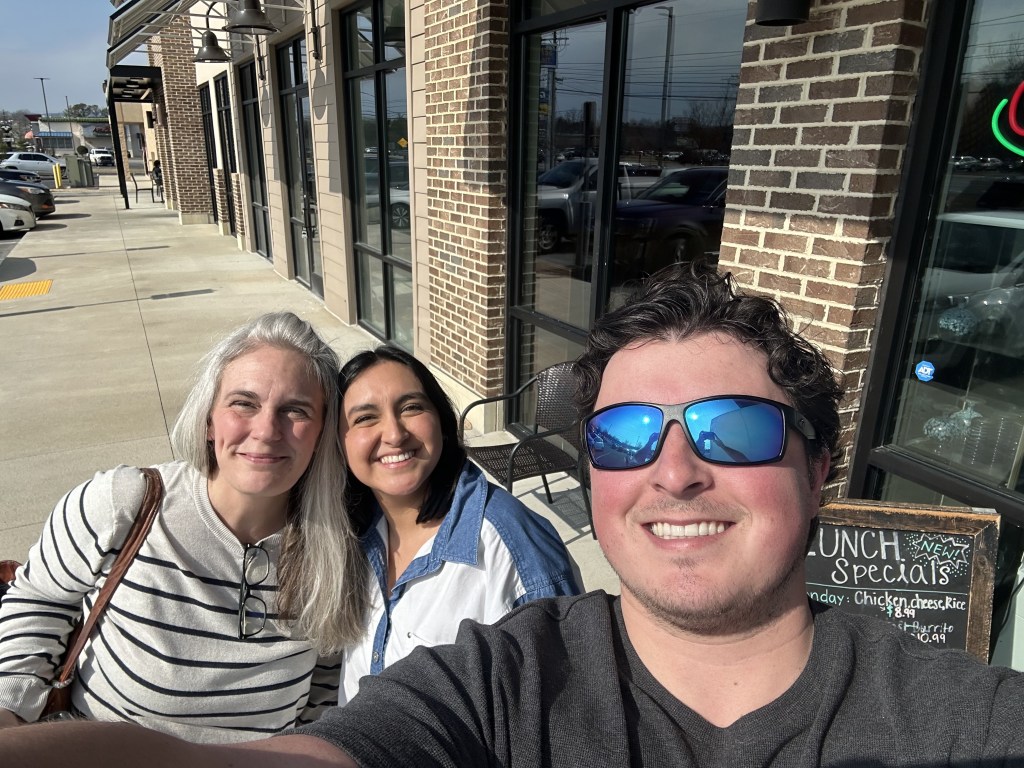
Who: Melanie and Carson

Church: Hope Church Catoosa

Lunch: Corazon De Mexico

Topic: The Connection between Church and Community

I don’t remember the first time I met Melanie, but in a city like Chattanooga, you see familiar faces all the time. (Jamie won’t go to certain places with me anymore because the moment we walk in, I inevitably stop to chat with at least three people I know.) It’s not that Chattanooga is small—it just has this way of making itself feel like a close-knit community, where paths cross again and again, sometimes without you even realizing it.

A few months ago, Sydney and I were attending a workshop and ran into Melanie again. We got to talking about life and I shared this little writing project with her. After explaining the intent behind it—how it was less about finding answers and more about connection and a collective purpose — she told me it reminded her of some of the conversations she and her husband had been having lately, about faith, community, and the level of intentionality we choose to bring into our relationships and daily lives. She spoke about how easy it is to go through the motions—showing up, saying the right things, but never truly engaging with the people around us.

And that’s when I knew Melanie was our kind of people.

One of the first things that stood out to me during my visit to Hope Church was the genuine engagement of the lead pastor as people walked through the doors. Rather than standing off to the side or waiting until the service began to interact, he was fully present—greeting people with warmth, striking up conversations, and making sure everyone felt seen and welcomed. It was clear that his role extended far beyond the pulpit; he was actively building relationships, setting the tone for a church culture that values connection and belonging from the moment you step inside.

You might be surprised—or maybe not—by how many pastors carry themselves more like rock stars than shepherds. It’s not uncommon to see church leaders who are distant, guarded, or even unapproachable, treating the pulpit like a stage and the congregation like an audience rather than a community. Some seem more concerned with crafting a brand or maintaining an image than with truly knowing and walking alongside their people. That’s why it was so refreshing to see a pastor who was fully present, engaging with people on a personal level, and prioritizing relationships over performance. I also want to acknowledge that many of the churches I’ve visited in Chattanooga have pastors who genuinely embody this kind of leadership—engaged, present, and deeply invested in their congregation.

But not all of them have.

There were a few noteworthy moments in the sermon, which was part of a series on the Book of Revelation. One that stood out was when the pastor emphasized a motto he often returns to: “We Welcome All & Affirm None.” I have to admit—this wasn’t the direction I originally planned to take with this post. In fact, after the service, we barely spent five minutes discussing it. But for some reason, the phrase has lingered in my mind all week, turning over and over in my thoughts. And when something stays with me like that, I know it’s worth exploring. So, this is where I’m choosing to spend my time this week.

First, a phrase like this can raise several theological concerns, particularly regarding the biblical balance between grace and truth, the nature of Christian love, and the role of affirmation in discipleship. (I also want to note that I don’t believe this is the case at Hope Church.) Scripture shows that affirmation is not inherently negative; rather, it is about affirming what is true, good, and in alignment with God’s design. Paul often affirms the faith and growth of believers (Philippians 1:6, 1 Thessalonians 1:2-3). Refusing to affirm anything could imply that spiritual growth, repentance, and obedience are irrelevant, which contradicts the biblical call to encourage and build up one another (1 Thessalonians 5:11, Hebrews 10:24-25).

But, from my experience, when it comes to the topic/discussion of “affirming” it’s typically around the LGBTQ+ community. (And the pastor acknowledged during the sermon that he gets asked about the church’s position on certain things that has caused him to create the motto.) So, if this motto is primarily, or even tangentially, about LGBTQ+ inclusion (or lack thereof), it raises significant theological and pastoral questions that I wish more faith communities would grapple with openly. (My intention here to engage with the broader implications of a phrase like this—how it’s received, what it communicates (intentionally or not), and what it means for those seeking a faith community.) I believe this is something worth reflecting on in faith communities everywhere.

Over the past week, these are some of the notes I jotted down in my journal:

  • Does “affirm none” apply equally across all areas of life (e.g., marriage, leadership, spiritual gifts, repentance, justice issues)?
  • If the church affirms married heterosexual couples, people serving in leadership, or members who share a particular theological perspective, then it’s not actually “affirming none”—it’s just selectively choosing who and what to affirm.
  • This can reveal an inconsistent theology, where some groups receive encouragement and validation while others are subtly excluded.
  • Jesus welcomed everyone—including those marginalized by religious authorities (Matthew 9:10-13, Luke 19:1-10).
  • A better approach might be clearly articulating the church’s beliefs while also ensuring that LGBTQ+ individuals (and others) are treated with dignity, respect, and pastoral care.

When it comes to this conversation, the bigger issue is whether the church—any church—is willing to engage in honest, compassionate conversations about faith, sexuality, and identity. Avoiding clarity on these matters does not preserve unity; it often creates confusion, unspoken tensions, and deep wounds among those seeking spiritual guidance. The church is called to be a place of truth, grace, and transformation, but that requires a commitment to transparency, consistency, and humility in addressing complex issues.

And this isn’t just about the LGBTQ+ community. The conversation around sexuality in the church has long been marked by double standards, particularly within purity culture. (And this is just one example.) Many church communities have emphasized sexual purity in ways that disproportionately affect women, often linking their worth to their sexual past while allowing men more grace and redemption. Young girls have been taught that their bodies are “stumbling blocks” for men, placing the burden of purity on them rather than addressing the need for mutual responsibility and heart transformation in both men and women. How many times have young women been asked to wear shirts over their bathing suits compared to the number of times young men have been asked to do the same? In all the years of ministry, I can’t think of one instance where a boy was asked to cover up.

Not one. (And I’m embarrassed to say that I never questioned it. I never spoke up. I never asked why the burden of modesty always seemed to fall on the girls, why their bodies were treated as distractions while the boys were given a free pass. I heard the rules, saw them enforced, and let it happen without pushing back. And now, looking back, I realize that silence—even unintentional—is a form of complicity.) I even apologized to my girls for not recognizing the double standard sooner.

In this particular post, I find myself lingering on six words—six words that carry weight, shape perspectives, and spark conversations that might not otherwise happen. Words have power; they can welcome or exclude, clarify or confuse, heal or wound. And when a phrase is put forth by a church—an institution meant to reflect the love and truth of Christ—it becomes even more crucial to examine not just what is being said, but what is being left unsaid.

I will also say this: I think the motivation behind the creation of this motto came from a genuine place of wanting people to feel welcomed, to know they have a place in the church, regardless of their background or struggles. I don’t doubt that the intention was to create a space where anyone could walk through the doors without fear of immediate rejection. I saw it throughout the membership of Hope Church.

But I’ve also seen where intention and impact don’t always align in so many other communities. And, collectively, we must start asking ourselves: Do our words truly foster belonging, or do they establish an invisible line between being welcomed and being fully embraced? (And, I’m not talking about a motto here.)

Sometimes the chasm between being welcomed and being fully embraced is wider than we realize. So many churches that I’ve visited through the years have prided themselves on being welcoming, but welcome without belonging can feel like an open door that only leads to a waiting room. And if people sense that they’ll never move beyond that threshold—never be seen, known, and loved for who they truly are—then is it really welcome at all?

CHALLENGE: What comes to mind when you hear the phrase: There is a difference between being welcomed and being fully embraced. How does it sit with you? Have you experienced either, or both?

I encourage you to wrestle with these questions—not just in isolation, but in conversation with others. Sit down with trusted members of your community, especially those whose theological perspectives differ from your own. Ask them what they hear in these words, how they interpret them, and what they believe is at the heart of such a statement.

Conversations like these are not always comfortable, but they are necessary. True community isn’t built on avoiding differences—it’s built on the willingness to listen, to challenge, and to grow together. So, take the time to engage. Lean into the tension. Because the way we talk about welcome, affirmation, and belonging says far more about our faith than a church motto ever could.