
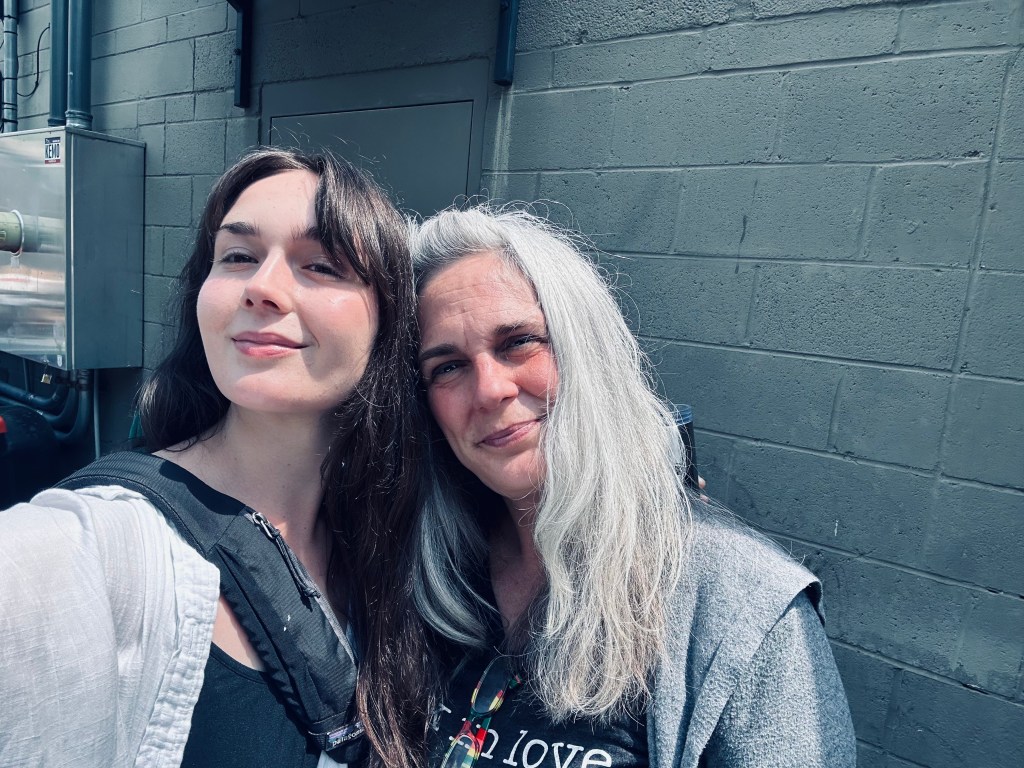
Who: Sydney
Church: First Centenary United Methodist
Lunch: The Daily Ration
Topic: Traditions and Cultural Christianity
Today’s post begins with a backstory.
When our kids were little, Easter rivaled Christmas in sheer extravagance—overflowing baskets, egg hunts that stretched across the yard, chocolate bunnies the size of their heads. It was magical in its own way… but none of it had anything to do with Jesus.
But alongside all the Easter baskets and bunny-shaped pancakes, we also had traditions that grounded us—rituals that pointed our family back to the heart of the Gospel and the life of Jesus.
My kids grew up serving breakfast at a local community center on Christmas morning. Before a single present was unwrapped, we’d pack up the leftovers and deliver them to people camped outside the local soup kitchen. It became a rhythm for us—something we did alongside another like-minded family. And over the years, others joined in. It was simple, but sacred. A way of reminding ourselves (and our children) that the story of Jesus always moves outward—toward the margins, toward the overlooked.
And not just on Christmas.
Our family began partnering with a local church in downtown Portland, just two blocks from the city’s main soup kitchen. Every morning, we would walk the surrounding streets, inviting anyone we met to join us for breakfast at the church. What began as a simple meal quickly grew into something much deeper—we spent our mornings building real friendships with the very people we had once only passed by in our daily lives.
One year, a few weeks before Easter, I approached our church leadership, hoping to extend the invitation to the larger congregation. I thought: What if this became part of our shared story? A way for us, as a community, to embody the Gospel together?
But the response I received still baffles me.
Our Lead Pastor mentioned that he had been meaning to talk to me about our “little project.” I’ll admit, for a moment, I felt a flicker of excitement—maybe the church was beginning to catch the vision and see the potential of what we were doing. But that hope quickly faded when his expression shifted to one of concern. He went on to share that several members of the congregation had voiced worries about what we were allowing our children to do—specifically, spending time downtown and interacting with people they considered dangerous.
It was a sobering reminder that fear often speaks louder than faith when the unknown is involved. And it weighed even heavier as Easter approached, when our services were filled with flowers, banners, and celebration. Because while we sang about resurrection and redemption inside, the very people Jesus called us to love were considered a danger to their safety… or maybe it was something else.
It made the pomp and circumstance of Easter feel hollow. How could we proclaim “He is risen!” with such triumph, yet overlook the ones He rose for? How could we decorate the sanctuary while ignoring the suffering that sat just a few blocks away?
The contradiction wasn’t lost on me—and it changed me.
So, Easter services, like Christmas services, are hard ones for our family to stomach. But, Sydney agreed to go with me this year and some things went as expected… and some things were a pleasant surprise.
I must first note that we went to the wrong service. First Centenary had two distinctly different services: one in the main sanctuary and one in The Vine. Sydney and I ended up at the service in the main sanctuary, which was beautiful — both the sanctuary itself and the service. (Also, a HUGE shout out to the solo female vocalist who literally made me cry. Her voice was truly angelic and one of the most moving parts of the morning.)
That being said, “high liturgy” is a stumbling block for our family. It’s not that we don’t value tradition — we do. There’s a reverence and a rhythm in liturgy that can be deeply meaningful. But for us, especially after the journey we’ve been on, it can feel like a barrier rather than an invitation. Sometimes, the structure can feel so polished, so choreographed, that it’s hard to find the messy, human connection that we’re longing for in a faith community. It can feel like we’re being asked to participate in a beautiful performance, rather than being invited into a relationship that allows for questions, doubts, tears, and imperfect hope.
It’s not a critique of First Centenary — the service was deeply heartfelt, and it clearly means a great deal to the people who call that community home. It’s simply a recognition that, for us, we are drawn more toward spaces that feel raw and even a little unfinished — where the beauty lies not in the perfection of the service, but in the imperfect people who gather to remember why they need grace in the first place.
But there was something that immediately catapulted First Centenary to the top of an unofficial (but very real) list in my mind — a list of churches in Chattanooga that I would not only happily visit again but would wholeheartedly support in the future.
On Easter Sunday — one of the highest attended, most celebrated days in the Christian calendar — they chose to give their entire Easter offering to Bridge Refugee Services. In a world where churches often focus Easter giving inward, toward building campaigns or operational needs, First Centenary chose to look outward. They chose to see, to honor, and to invest in some of the most vulnerable members of our community — families and individuals who have fled unimaginable hardship to seek safety and a new beginning here.
It would have been easy for them to make Easter about themselves: about full pews, grand music, and a polished production. Instead, they used the day to remind everyone in attendance that the heart of the resurrection is about new life, hope, and welcome — not just for us, but through us, for others. Their generosity wasn’t just a financial gift; it was a prophetic act, quietly but powerfully embodying the Gospel they proclaimed from the pulpit.
And that matters. It matters more than polished sermons or perfectly executed services. It matters because it shows a church willing to live their faith outside their walls, to let love lead the way, and to extend their hands to the stranger and the refugee — just as Jesus so often did.
And, yes, the decision at First Centenary reminded us of our old church in Maine — a place that also had a tradition of giving away their Christmas and Easter offerings. I still vividly remember the first year they did it, when I was working for a small ministry embedded in the heart of Portland’s refugee community. It was an organization deeply connected to the life of the church — financially supported by the congregation, led by one of our own elders, and struggling every single month just to meet budget.
It seemed like the obvious choice. The offering could have made an immediate and transformational impact, right in our own backyard, for a ministry the church already claimed to champion. I felt this swell of hope, believing that the generosity we talked about so often would naturally flow toward the people we said we loved.
But that didn’t happen.
Instead, the Easter offering went to the local children’s hospital — which, on the surface, seemed noble enough. After all, who’s going to argue with helping sick kids? But the decision wasn’t really about the hospital. One of the elders later confided that it was a strategic move. They hoped that by giving a large donation to the hospital, the doctors and staff might be impressed enough to consider attending our church — and, eventually, boost the monthly tithes. (This wasn’t an assumption we erroneously created. This was the literal explanation given.)
It wasn’t about generosity. It was a gamble, a calculated investment in the hopes of a future financial return. And it felt gross…because it was.
It felt like everything Jesus came to turn upside down — the leveraging of power, wealth, and influence to serve ourselves, wrapped in the language of compassion.
That’s why First Centenary’s decision this Easter struck such a deep chord. They simply looked at who was hurting, and they gave. No strings attached. No ulterior motives. Just love, offered freely, the way it’s supposed to be.
And to be a part of that, in the smallest of ways, was a reminder that the Church, at its best, doesn’t have to impress, strategize, or perform. It just has to love. Quietly. Faithfully. Tangibly. And when it does, even a simple Easter offering can become a glimpse of the Kingdom breaking through.
 Searching for Jesus in A̶m̶e̶r̶i̶c̶a̶ Chattanooga
It was a blessing to have you worship with us!
Rev. Jason Gattis
LikeLike
Definitely our pleasure. And thank you for supporting our work in the community through the Christmas offering. Your community has offered so much healing to our family and this community.
LikeLike